Latest Updates
Who's Online

Please sign in to add comments

Cart Contents
| Item: | Price: | Qty: |
|---|---|---|
| Total: R 0.00 | ||
User Content
Latest Poll
Feature
Lockdown Gaming Day 24: Journey
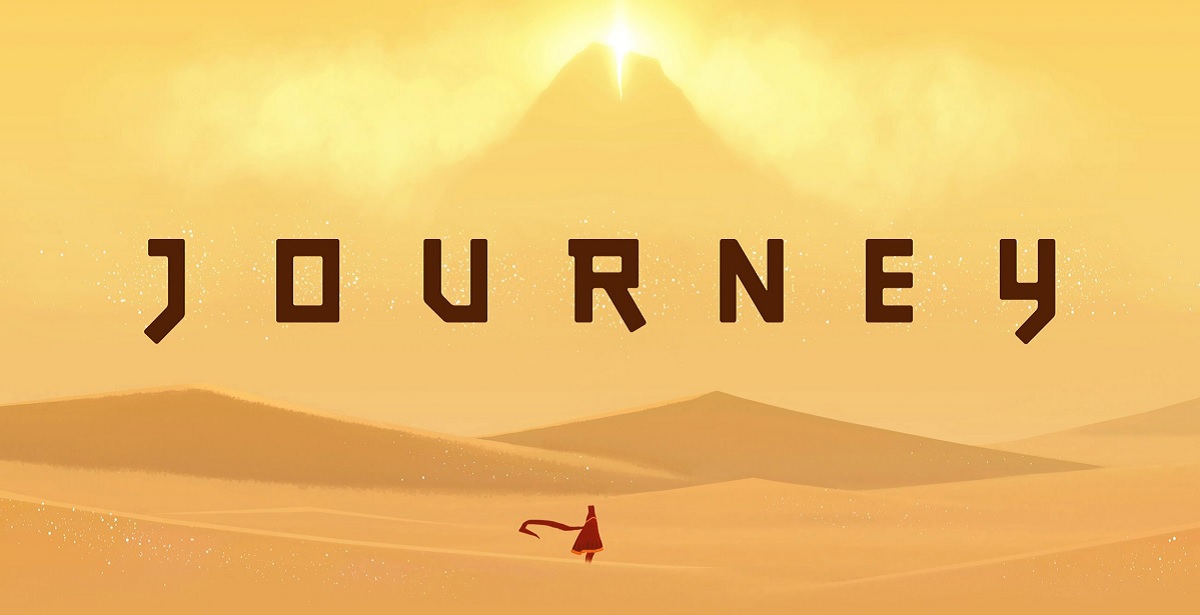
As South Africa enters its 21-day lockdown (UPDATE: Now extended by two weeks) in order to combat the spread of the coronavirus, it has left many civilians in the isolation of their homes. Many see this as a great opportunity to spend quality time with some family and loved ones, while others cherish diving into forms of entertainment to occupy their time and pass the weeks (when not working remotely, in that case). To cushion some of the tedium, Nexus has decided to create a daily feature in which we recommend games of varying lengths and content that could pass the time. Our twenty-fourth recommendation in Lockdown Gaming is one of the best games of all time, the awe-inspiring Journey.
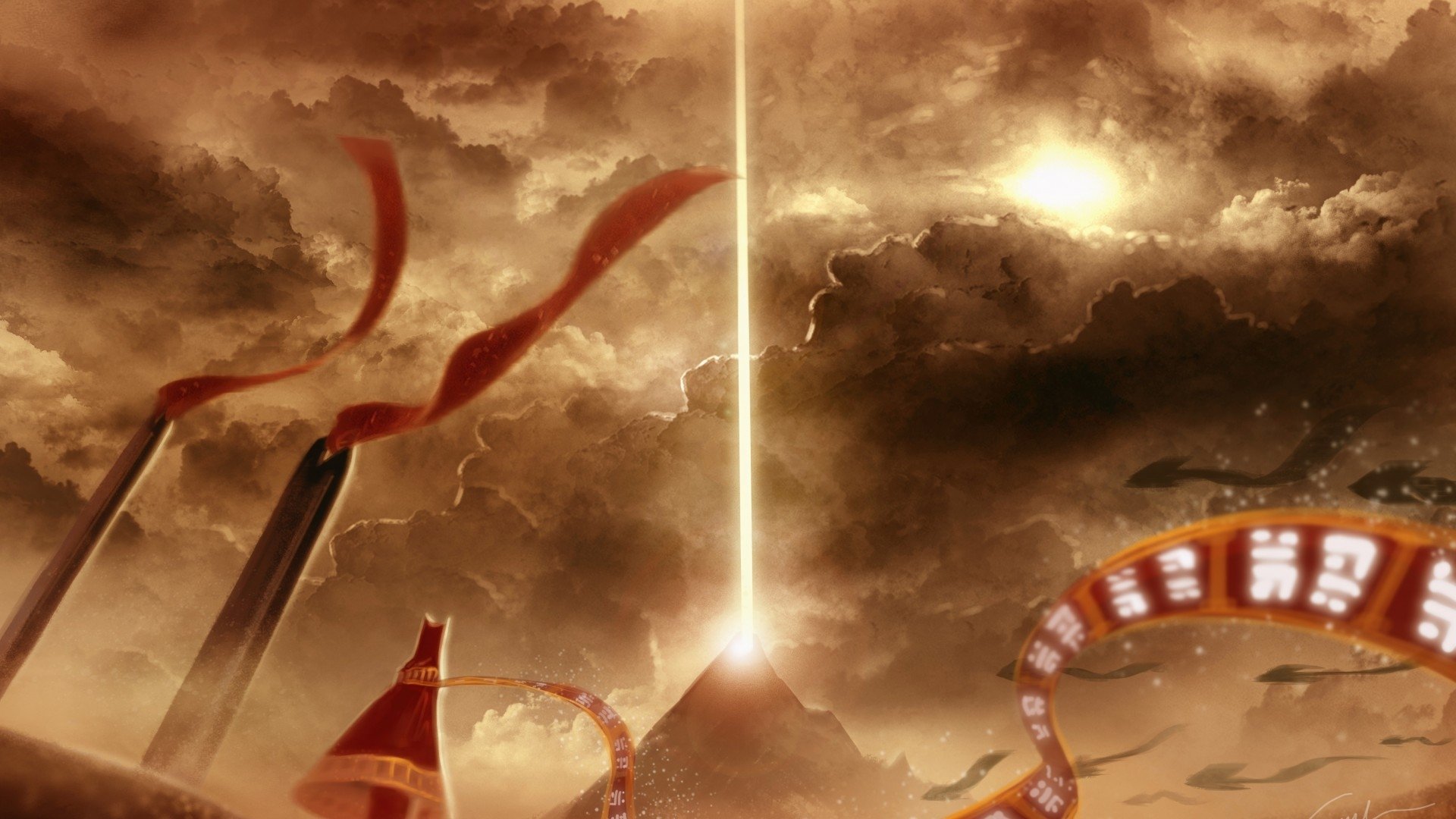
When I first played Journey, it was at the peak of my interest in indie games. This was at a time when Indie Game: The Movie introduced me to some of my current favourite games like Super Meat Boy and Fez, while Limbo gave me the artistic representation of darkness that my edgy teenage self always craved. However, upon the release of thatgamecompany's Journey, something clicked within me that, for all intents and purposes, completely changed my life. Yes, today we're talking about one of those life-changing games, and there's no better example than this.
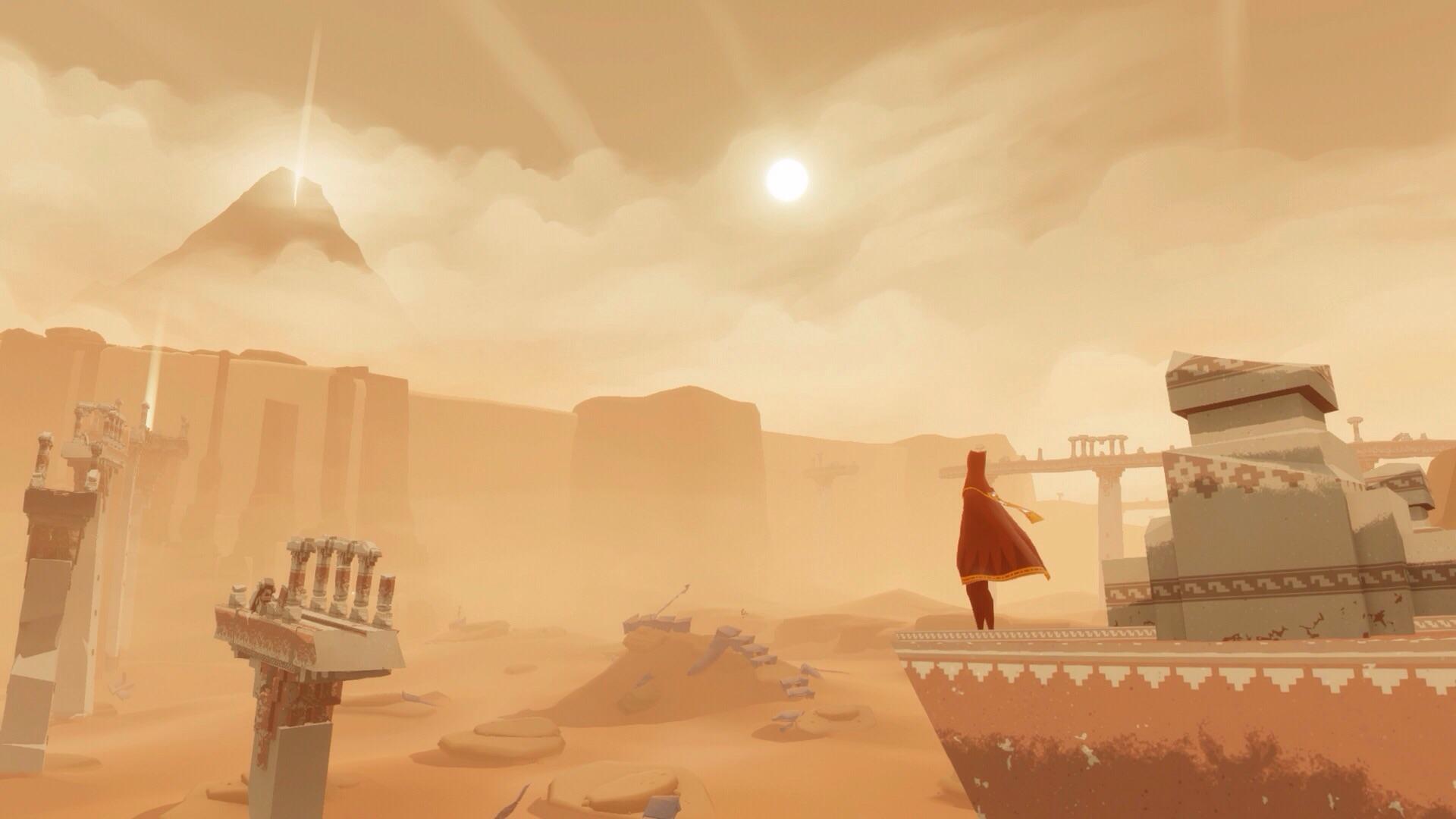
Journey puts us in the cape a desert traveler who one day awakens in the shadow of an enormous mountain emitting a bright light from its peak. The traveler, seemingly with nowhere to go, decides to climb the mountain and find out exactly what that strange light is. Along the way, the traveler may or may not run into other companions to venture up the mountain with, all the while taking in some breathtaking scenery, solving puzzles, and braving harsh climates. Journey is as the title suggests: a game about the journey, but one with a profoundly devastating and self-reflective destination.

For the sake of digging deep into the core themes and ideas of Journey, I will be spoiling the ending from here on out. You have been warned. From a game design standpoint, Journey opts for the "simpler is better" route by not littering the environments with collectibles or meaningless side fluff, but rather just lets the player bask in some of the levels' more serene and stunning beauty. There are hidden secrets to find, but it never feels like its at the expense of exploration and soaking in the scenery. Exploring the different diverse landscapes is engaging and, in some cases, quite haunting.
The player character, this unnamed traveler, only has a couple of gameplay mechanics to work with. Namely, the traveler's scarf will expand in length that allows various actions to be performed such as gliding and boosting. They can also communicate with other players in the world through sound pings, making it rather difficult but undoubtedly ingenious to coordinate tactics and puzzle solutions as players now have to convey their thoughts in action rather than words, and it works to the game's multiplayer benefit. Most of all, this only stresses the message of bonding with complete strangers, undertaking this incredible journey together despite never truly knowing anyone beyond the surface level. I can't tell you how many times I felt like I had become best friends with my companion, only for them to disappear at the end of the game and leave an empty void.
The only enemies you'll ever come across are gigantic floating serpent-like statues who scout the levels for the traveler (or any signs of life, really). They attack any intruders upon detecting them, and these can often result in a one-shot kill if not careful. Their all-seeing eye acts like a giant spotlight as it glides over the landscape, making avoiding them pretty intense and some of the best (and only) stealth sections in the game. Things naturally ramp up towards the end, though, but you never really encounter other enemies as dangerous as these flying stone beasts.
Now we get to the ending of the game. Assuming you followed my previous spoiler warning, head back, play the game to completion (it's only 2-3 hours) and return here. When you're finally at the cusp of the mountain's peak, with the beam of light in the close distance, the player must trudge through thick snow to get to the top. The only thing is, the player dies here. They never truly reach the summit. Their body is whisked away by an angelic figure, and taken to another plain of existence - you guessed it, the top of the mountain. A land overflowing with huge waterfalls, flying graceful creatures, and gorgeous valleys as far as the eye can see. Some might call it paradise.
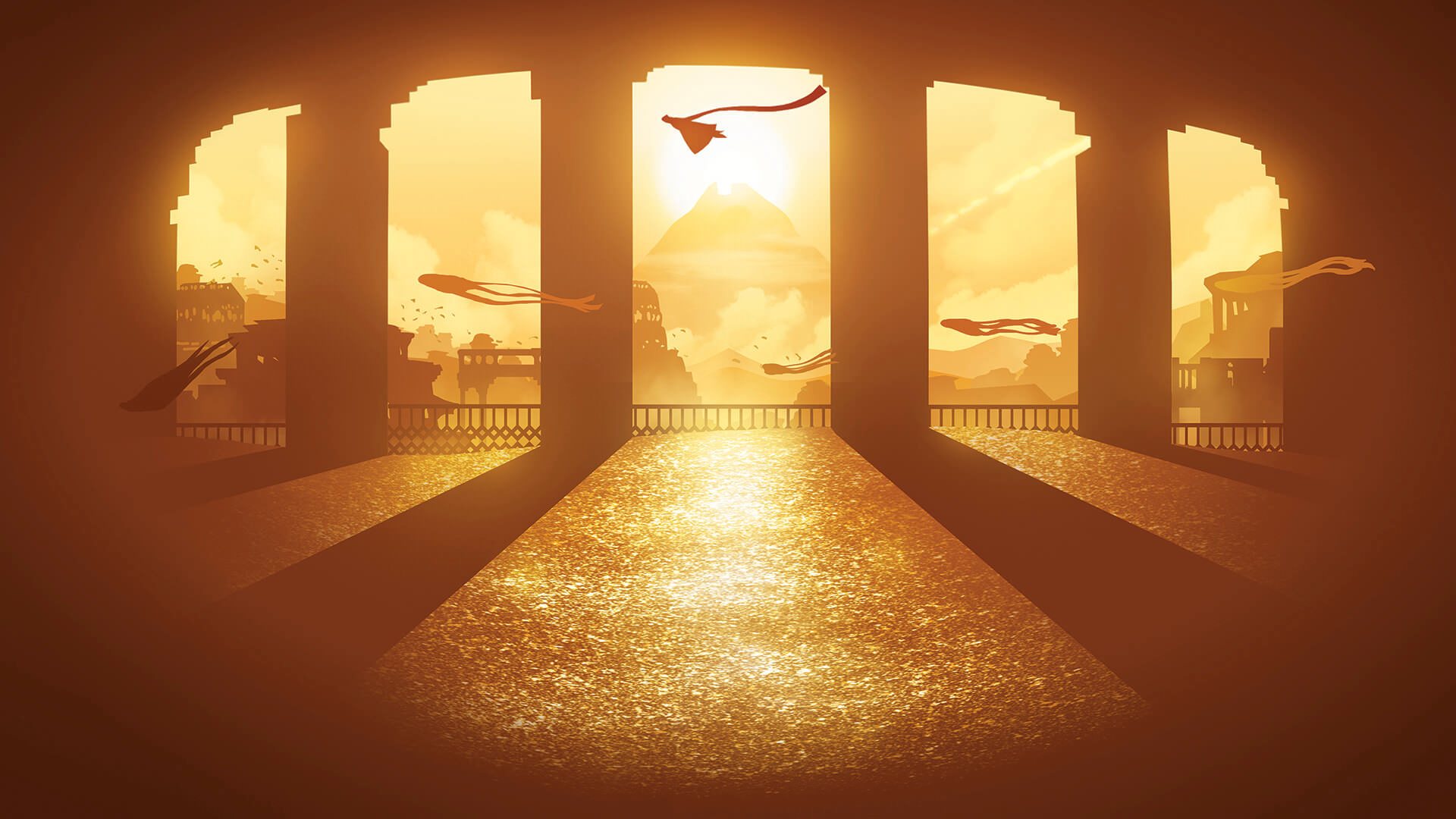
Journey doesn't just drop this bombshell on players out of nowhere, though. Throughout the game, you'll constantly come across grave sites with tombstones, signalling the death of travelers before you. The narrative only dips its feet in the idea of "angels" or beings from other realms watching over the mountain through glyphs etched on walls in another foreign language. The traveler - the player - is but one of millions who all attempted to journey to the top of the mountain but died along their path to get there. The angels then take the souls of the dead to the top of the mountain, this valley of paradise, only to guide them into the light and... reincarnate them as another weary traveler awakening in the desert, wondering what that strange light is on the mountain. Thus, the cycle begins again.

It's easy to miss the point of Journey entirely and simply see it as a game about a bloke who sees a shiny light on a mountain and dies trying to get there. However, that's the beauty of a game like this. It's open to interpretation in so many ways. Personally, I think it reflects a very real societal theme of the journey being our lives, and the light on the mountain being the end goal of self-fulfillment and meaning to life we're so desperately trying to reach by being good people and helping others. Some may die getting there, at different intervals of the journey, but the destination (death) is always the same and unchanging. The way I see it, death and the meaning of life are one and the same. Upon death, we're meant to reflect on our lives and see how much we actually accomplished in our journey to get there. That, in the pursuit of life's meaning, is the meaning of life. The journey.
But hey, it could just be a game about a lost desert nomad climbing a mountain too. Who knows. I'd like to finally give a shoutout to Journey's soundtrack composed by Austin Wintory. It's one of the most beautiful, mystifying scores ever put to a game, if not the best.
Journey is available for free right now via PlayStation's great Play At Home initiative, and I strongly urge people to play through one of the most tragically beautiful games of our time.
Other Lockdown Gaming Features:
Lockdown Gaming Day 1: Skyrim Special Edition
Lockdown Gaming Day 2: Persona 5
Lockdown Gaming Day 3: Fallout 4
Lockdown Gaming Day 4: NieR: Automata
Lockdown Gaming Day 5: Bloodborne
Lockdown Gaming Day 6: Anthem & Fallout 76
Lockdown Gaming Day 7: Alien: Isolation
Lockdown Gaming Day 8: Final Fantasy VII
Lockdown Gaming Day 9: Grand Theft Auto: San Andreas
Lockdown Gaming Day 10: Portal
Lockdown Gaming Day 11: Resident Evil 2 Remake
Lockdown Gaming Day 12: Limbo
Lockdown Gaming Day 13: Uncharted 4: A Thief's End
Lockdown Gaming Day 14/15: The Witcher 3: Wild Hunt - Game of the Year Edition
Lockdown Gaming Day 16: Ratchet & Clank (PS4)
Lockdown Gaming Day 17: Resident Evil Origins Collection
Lockdown Gaming Day 18/19: Final Fantasy XV
Lockdown Gaming Day 20: The Witness
Lockdown Gaming Day 21/22: Assassin's Creed Odyssey
Lockdown Gaming Day 23: Resident Evil 3 Remake
Remember to visit the South African Coronavirus Website for more information on safety and prevention tips. Stay safe!
Emergency Hotline: 0800 029 999
WhatsApp Support Line: 0600-123456
Please show your support for Nexus during the lockdown by assisting us with our fundraiser to support the staff and ensure we can keep bringing you quality writing, retail, and more! Thank you kindly! Campaign Page Here.

Please login to post comments.
More Features
10 Witchy Anime to Get You in the Spooky Spirit This October
With October here, that means only one thing: spooky season has arrived! In the lead-up to Halloween...
09-10-26 Read more

Comic Con Africa 2026 Wrap-Up
Comic Con Africa is one of the biggest events of the year, hosting over 70,000 people across a span ...
30-09-26 Read more
New and Returning Anime This October 2026
With October bringing a new change in season as well as Spooky Season, it also brings in a new anime...
29-09-26 Read more

MSI Modern A15 AI+ vs Cyborg 15 vs Crosshair 17 HX AI: Which MSI Laptop Should You Buy in South Africa?
There was a time when buying a laptop was relatively simple. You found one within your budget, checked...
28-09-26 Read more

Top 10 Things To Do at Comic Con Africa 2026
Comic Con Africa opens its doors this week as South Africa’s premier destination for all things geek...
23-09-26 Read more

Shoma Govender's Game Over Cancer Campaign Taps Into Tabletop & Board Gaming at Nexus Hub
Gaming communities are often at their best when they come together for something bigger than the games...
22-09-26 Read more

Comic Con Africa 2026 International Guests Roundup
With Comic Con Africa 2026 only a week away, the excitement and hype is slowly building towards the ...
15-09-26 Read more
BlizzCon 2026: All the Biggest Announcements
After taking a three-year break, BlizzCon has finally returned, and Blizzard had plenty to announce...
14-09-26 Read more

Cyberpunk 2077 Would Be Even Better If It Were More Deus Ex And Less Assassin's Creed
Five years, a dozen major patches, and one sizeable expansion have evolved, expanded, and improved Cyberpunk...
07-09-26 Read more

Mrs South Africa Finalist Shoma Govender Launches Game Over Cancer Fundraiser
For Mrs South Africa finalist, Shoma Govender, the journey towards the crown has become about far more...
05-09-26 Read more