Latest Updates
Who's Online

Please sign in to add comments


Cart Contents
| Item: | Price: | Qty: |
|---|---|---|
| Total: R 0.00 | ||
User Content
Latest Poll
Review
Review: Saros
Hell in a handbasket.
.jpg)
Sony’s Housemarque makes a specific type of game – one that I admittedly only appreciated over the last year having played Returnal and Resogun for the first time. With Saros, the developer stretches its storytelling wings a bit more in an attempt to anchor its characters to a more narratively-driven experience balanced out with the insanity of its bullet-hell roguelike action. The result is perhaps the studio’s most refined game yet – a triumphantly bold third-person shooter that constantly keeps you on the edge of your toes, with one of the most satisfying gameplay loops I’ve played in a very long time.

The story of Saros is centred on Arjun Devraj (voiced and mo-capped by the talented Rahul Kohli), a Soltari officer who, together with his team of researchers and colonists, explores the dangerous alien planet of Carcosa. Lifting a few notes out of Bloodborne’s pages, a solar eclipse constantly threatens to reshape the land, making exploration and advancement a little more challenging with each run, playing into the unpredictability of its gameplay loop.
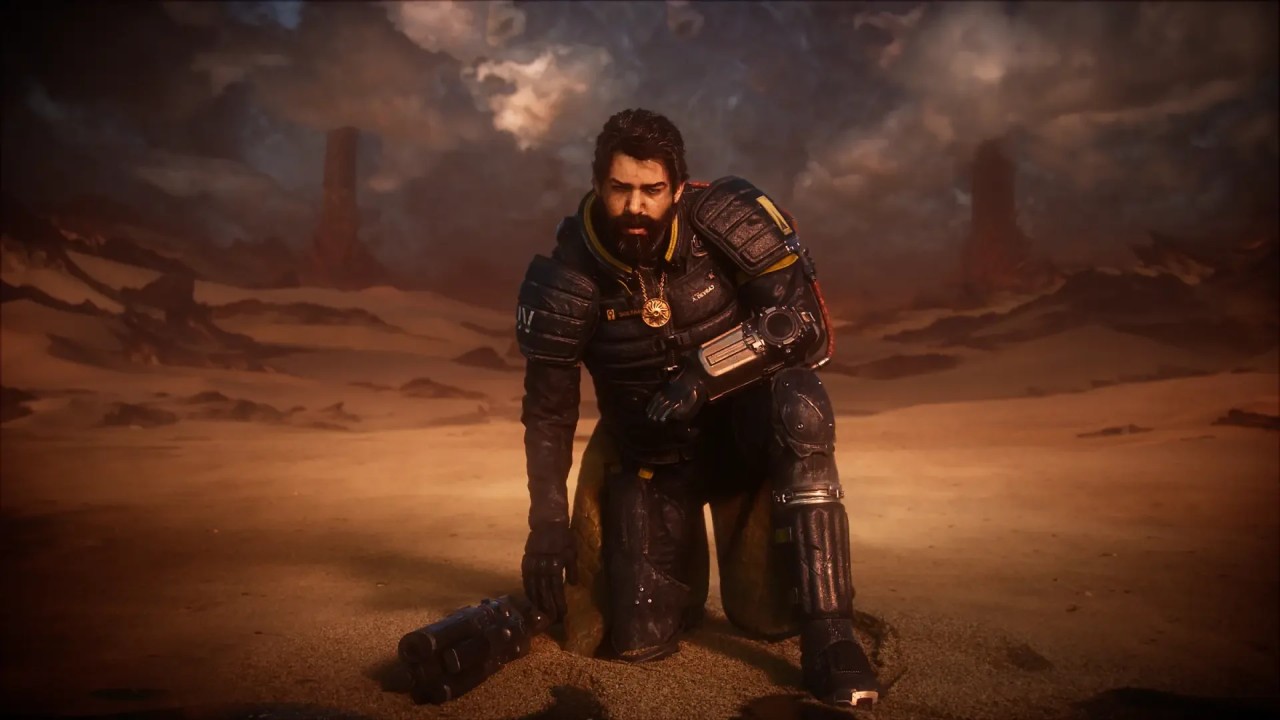
The story is ambitious, borrowing elements from classic stories like Heart of Darkness to tell a more grounded, humanising narrative as Arjun sinks deeper into the depths of Carcosa’s mysteries. This is quite literal – much like Returnal, Saros features a similar gameplay loop of resetting every time you die. The objective is to explore Carcosa’s various regions and zones while making further progress each run. The volatile nature of the eclipse switches things up a bit, ensuring no two runs are ever the same, for the most part. Enemies could be displaced or new, tougher foes could stand in your way.
Much like Returnal, Saros features a similar gameplay loop of resetting every time you die.
Housemarque leverages this roguelike structure to brilliant effect in Saros. I’d argue and say it’s done more confidently than Returnal. Each reset is a chance to familiarise yourself with the layout of the environments, picking the best optimal routes to progress while collecting new gear and upgrades to make repeated runs a little less gruelling. Overall, it’s a structure that most fans of the genre will immediately be intimately familiar with, only Saros chooses to remix its levels with new challenges on occasion.
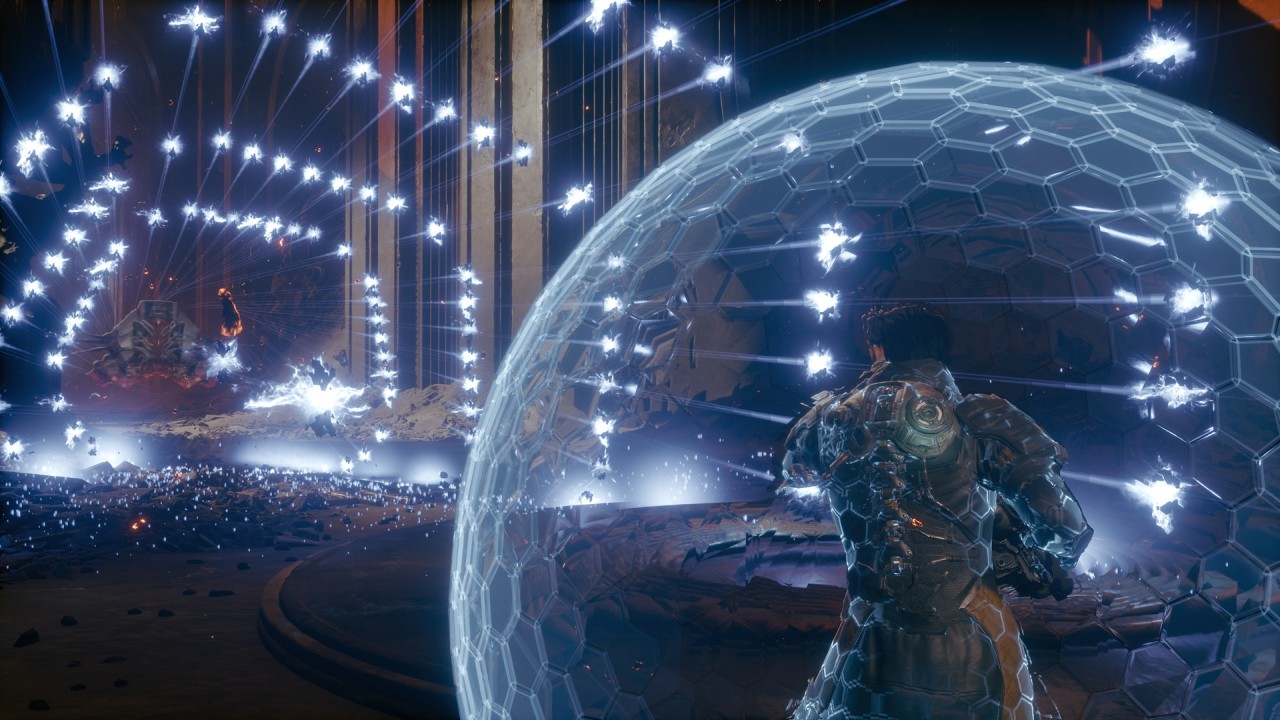
Due to this, the difficulty spikes in Saros could vary wildly. One run could be much easier than the next, all dependent on how the game switches up its enemy placements and routes. Just when you think you’ve figured a clear path forward, the game drops an often imposing challenge in your way, be it new enemies or platforming sections that require some tight precision. Thankfully, overcoming these challenges yields some great rewards and, if anything, it makes you a much better player. Housemarque understands this loop and nails the formula down to a tee with Saros. There’s a thrill you get from perfecting a run, your acquired skills and knowledge reflecting in each playthrough.
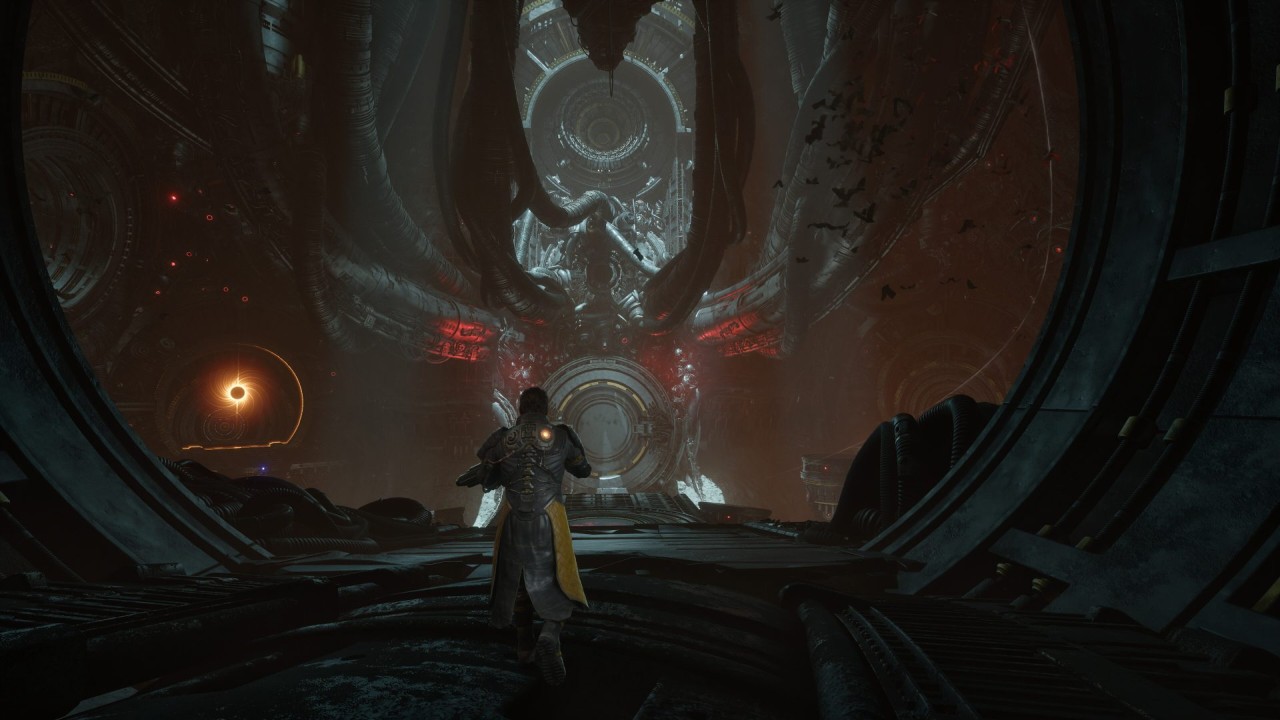
Saros leans heavily into its cosmic horror elements and the presentation is breathtaking. Inspired by H.R. Giger and other notable sci-fi authors and artists, the world of Saros is desolate, hauntingly beautiful and always terrifying to explore because you’re never quite sure what to expect around the corner. Armed with an arsenal of weapons including your ever-reliable pistols, players never feel completely in control of a situation. I think that’s the beauty of Saros’ gameplay because it’s chaotic yet controlled in the best possible way.
If you’ve played Returnal, Saros is pretty much cut from the same cloth. Dodging, weaving, and looking for openings is the name of the game as you frantically zip around environments to avoid incoming attacks. It requires a lot of attention and skill you can only accumulate from failure because dying is part of that crucial, satisfying learning curve. The game primarily consists of sections either involving heavy combat, platforming, or a tough combination of the two. If you’re one to get easily frustrated, Saros will pretty much guarantee your anger issues. In more ways than one, Saros is an unforgiving game, the challenge on the same level as Returnal, in my opinion. Housemarque alleviates some of that difficulty jumps by giving players an auto lock-on with certain weapons so you never miss your shots, though turning these off unlocks more powerful shots that can decimate enemies. It’s a high risk, high reward playstyle that never falters.
The game primarily consists of sections either involving heavy combat, platforming, or a tough combination of the two.
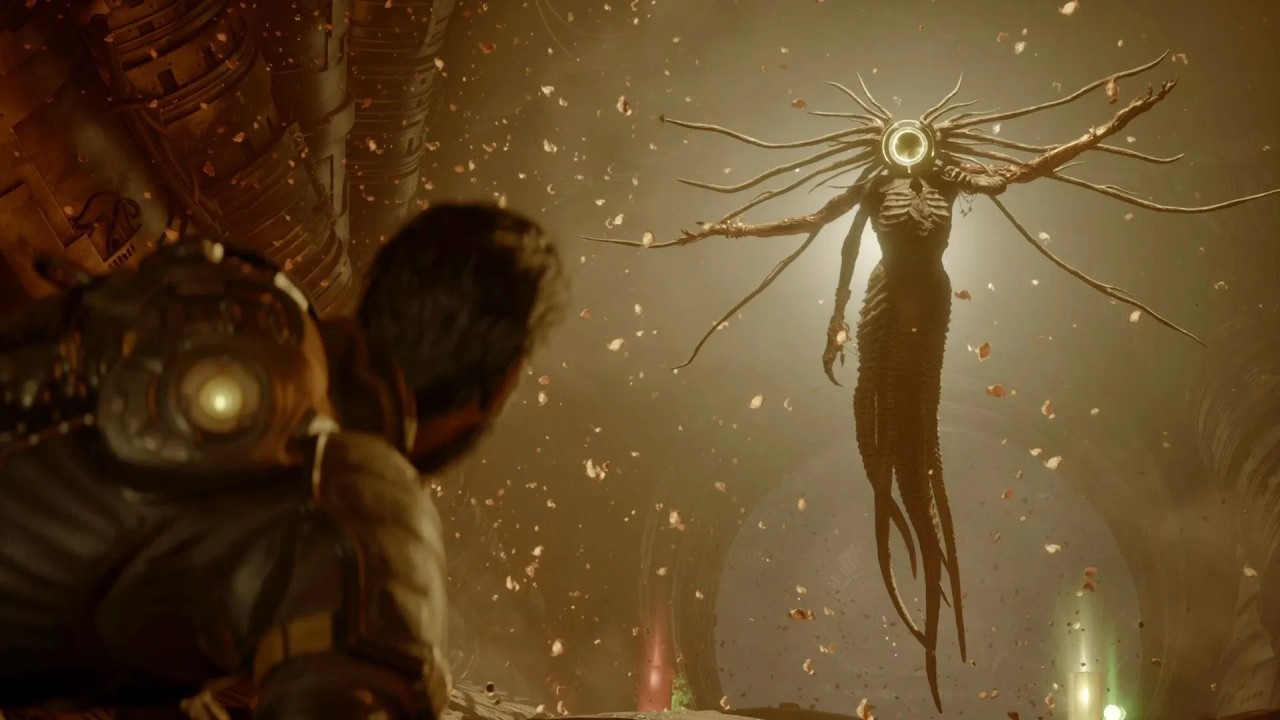
On the outset, Saros simply looks like more Returnal and that’s both a good and bad thing, depending on what the player is looking for. It’s not an evolution as much as it is a refinement of the formula established before. Arjun’s rapid movements are identical to Selene’s and you still get that rush of adrenaline when you conquer an extremely tough boss fight/cosmic biomechanical monstrosity (of which there are many, and they will repeatedly hand your butt to you on a silver plate).
The “joys” of that struggle mirrors Arjun’s mental collapse as he plunges deeper into the heart of Carcosa. It’s an ugly, grim journey that tests his patience and understanding (or lack thereof). On that note, Arjun is an incredibly compelling protagonist, brilliantly brought to life by strong voice acting and motion capture performance work by Rahul Kohli. He has a commanding, yet sympathetic presence; his frustration, concern for his colleagues, and fear portrayed wonderfully through the mo-cap. Housemarque have significantly improved their technical skills when it comes to delivering more convincing cinematics and performances. As it stands, Kohli brings one of the best performances of the year.
I reviewed Saros on PS5 Pro, encountering almost no issues whatsoever. It’s a testament to PlayStation’s first-party games arriving in almost pristine condition at launch. Even when particle effects exploded on-screen like fireworks in a disco, the framerate held steady at 60FPS on Performance mode. In a game that requires precision and quick movement, I’m glad it runs so smoothly.
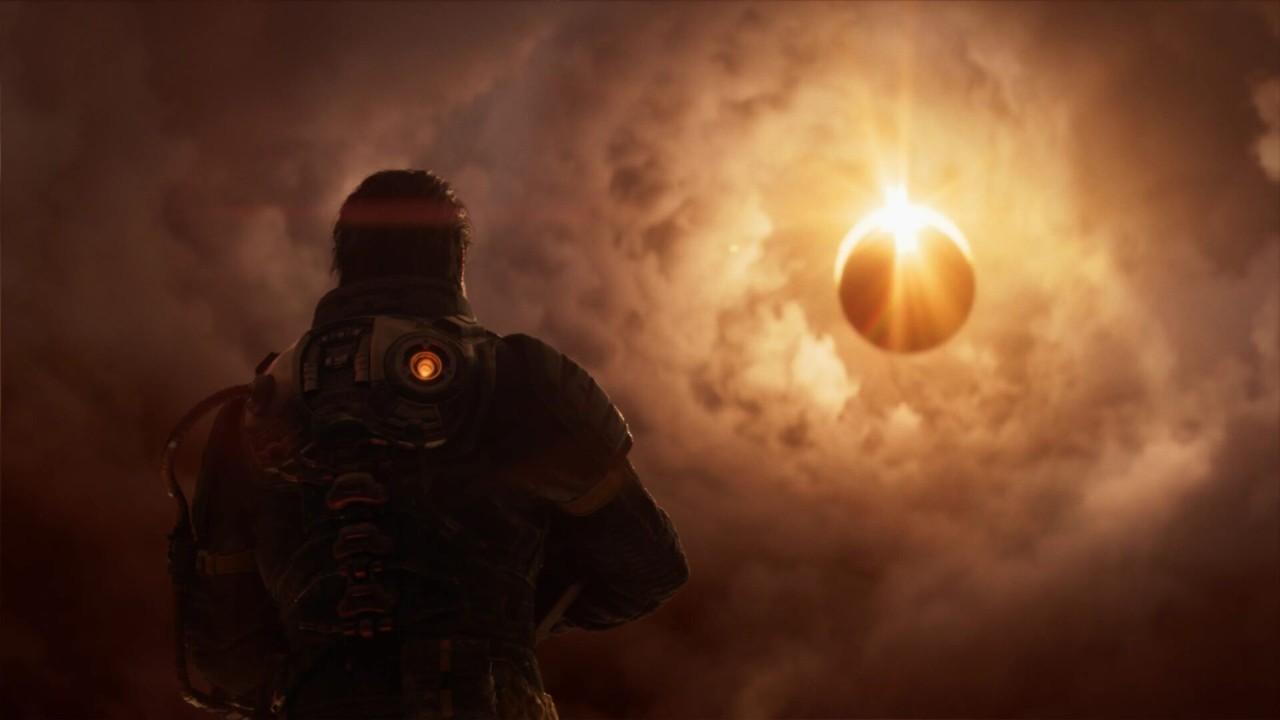
Housemarque also delivers one of the best implementation of the DualSense’s haptic feedback and adaptive triggers I’ve ever used on a PS5 game. You can feel the tension of the trigger when you pull back – a half-trigger initiates a normal rapid-fire while holding the button down allows you to charge up big attacks. Every shot from your weapon reverberates through the controller, making it feel like you’re actually holding a powerful gun. Essentially, Housemarque has actually found a way to replicate the feeling of a real weapon in a DualSense. It’s absolutely mental and I love it.
Housemarque also delivers one of the best implementation of the DualSense’s haptic feedback and adaptive triggers I’ve ever used on a PS5 game.
The sound mixing, audio design and art direction also deserve a lot of praise. Saros isn’t the most graphically advanced game but thanks to its strong art direction and combat that explodes with colours, it’s a real eye-opener. The audio is superb as well, with satisfying gun clatters, otherworldly screeches from its alien horrors, and a booming soundtrack that would make Doom proud.
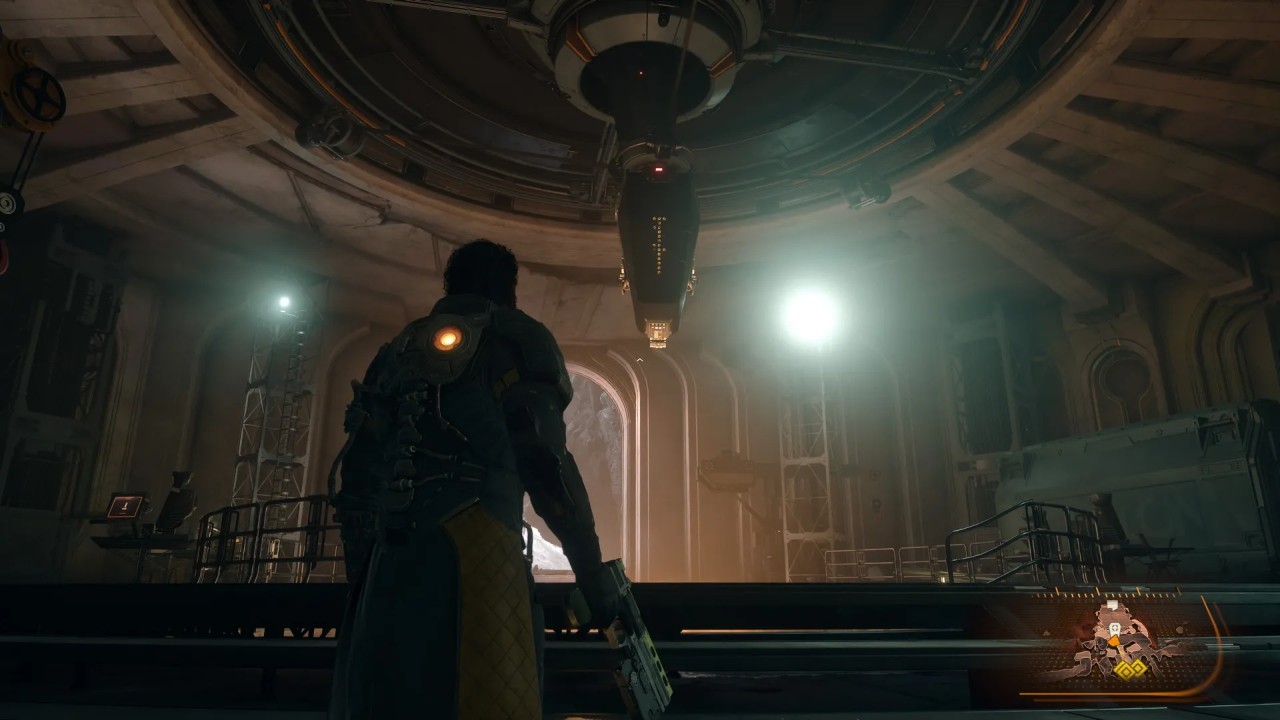
Saros is another incredible bullet-hell roguelike from Housemarque who are now the masters of their craft. With a deep, introspective story that almost hits all the right notes, fast-paced action that simply builds on Returnal’s strong foundations, and a riveting gameplay loop that sucks you in, forces you to lock in and never lets you go, it’s a challenging thrill that will test your patience. It won’t be a game for everybody – and some might be put off by how inaccessible and daunting it can feel with its difficulty spikes – but it’s a sure-fire contender for one of the best games of 2026 if you're brave enough.
PS5 Review code provided by PlayStation | Saros is available to pre-order on Nexus Hub at R1,299


Please login to post comments.
More Reviews
Review: Marvel's Wolverine
When I think about some of PlayStation Studios’ most consistent developers, Insomniac Games always ranks...
10-09-26 Read more
Review: Dumb Ways to Build
Originally a public service announcement which discouraged the Australian public from thoughtless activity...
09-09-26 Read more
Review: Orbitals
Booting up Orbitals for the first time, I was immediately hit by a warm wave of nostalgia like the food...
08-09-26 Read more

Review: Onimusha: Way of the Sword
It’s a good year to be a fan of action games, and an even better year to be a fan of Capcom. After delivering...
31-08-26 Read more

Review: Spa Weekend
I was invited to attend an exclusive preview screening of the film Spa Weekend on August 20th at Sandton...
21-08-26 Read more
Review: SanDisk Extreme Fit USB-C Flash Drive (128GB)
The SANDISK Extreme Fit USB-C™ Flash Drive - 128GB is something that you might not even believe exists...
21-08-26 Read more
Review: Ground Zero Hero
It’s not often that a game comes around with the ability to grip you into a mindless cycle of absolute...
19-08-26 Read more

Review: Marvel Tokon: Fighting Souls
You know, if anybody was going to make a Marvel themed arcade fighting game in 2026, I’m glad Arc System...
18-08-26 Read more

Review: Mortal Shell 2
With the boom of Soulslike games, developers now have to find interesting ways to mix up the formula...
17-08-26 Read more
Review: The End of Oak Street
The End of Oak Street is not what you’d expect just from looking at the name. You would think it’s maybe...
14-08-26 Read more

Overview

Add to cart
Developer
Housemarque
Publisher
Sony Interactive Entertainment
Platform
PlayStation 5
Release date
30 April 2026