Latest Updates
Who's Online

Please sign in to add comments

Cart Contents
| Item: | Price: | Qty: |
|---|---|---|
| Total: R 0.00 | ||
User Content
Latest Poll
Review
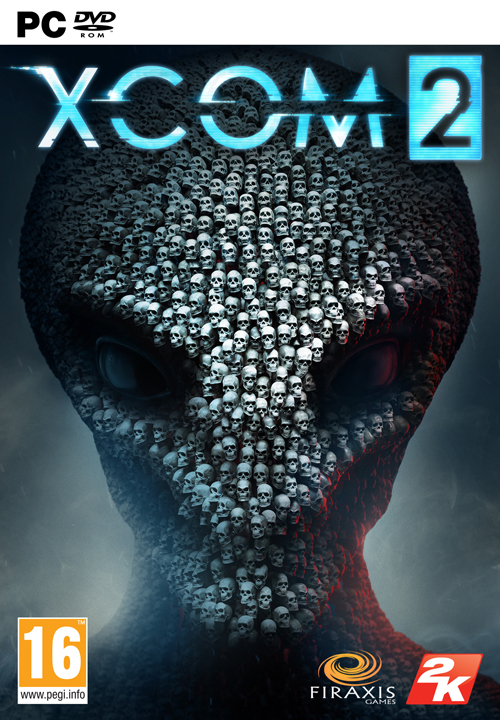
XCOM 2
Turn, Turn, Turn

Surprising everyone with XCOM: Enemy Unknown and the expansion, XCOM: Enemy Within, 2K and Firaxis have brought the conflict for Earth back, but just to PC this time around. This decision has been met with a little controversy, but has it led to a singular experience?
Story
Based on the majority of player experiences with Enemy Unknown (EU) and Enemy Within (EW), Firaxis took the bold decision to set the sequel twenty years after those games, with the player having failed to stop the alien invasion. The Advent and the Aliens defeated XCOM and conquered earth. Reminiscent of the B TV Show Earth Final Conflict and the more celebrated V, the aliens have presented themselves as benefactors bringing peace and prosperity to the citizens of Earth. The remnants of XCOM are now plucky rebels, fighting a guerrilla war with minimal resources, who are severely outnumbered at every turn.
The biggest improvement to your team is that you now have an insane number of options to customise the appearance of each soldier.
The tutorial mission effectively sets up the state of the world as you are tasked with rescuing an important character from EU and EW who has been held captive since the close of the previous game. This mission sets the stage for the countdown to the endgame, a mysterious project code named Avatar, which could spell doom for humanity unless XCOM uncovers the plot and manages to put a stop to the alien menace.
Design and Aesthetic
The design of the game deviates little from EU and EW, presenting updated character models, but overall the same UI and design philosophy. The colour palette still presents a bright and cartoony world, with your XCOM team probably the dourest of the character models at first, especially when compared to the variety of designs and colours used for the alien models. The new Sectoid is now a human pink, with the upgraded Mutons decked out in bright Green, and the Advent officers sporting stylish capes and helmets with red accents. One of the most striking designs is the new alien Viper, actually the true form of the Thin Man. A Viper is a cobra looking creature with a devastating attack that grabs your trooper from the carefully placed cover you put him behind.
The biggest improvement to your team is that you now have an insane number of options to customise the appearance of each soldier. At first this is limited to changing hats, glasses, and clothes, but as they advance you unlock tattoos, scars, and other cosmetic changes that you can make to your team. In addition to this expanded customisation is the Character Pool system. Through this new system you can create whatever your heart desires in terms of characters and their look. PCGamer have recreated various fictional characters, such as Kylo Ren from The Force Awakens.
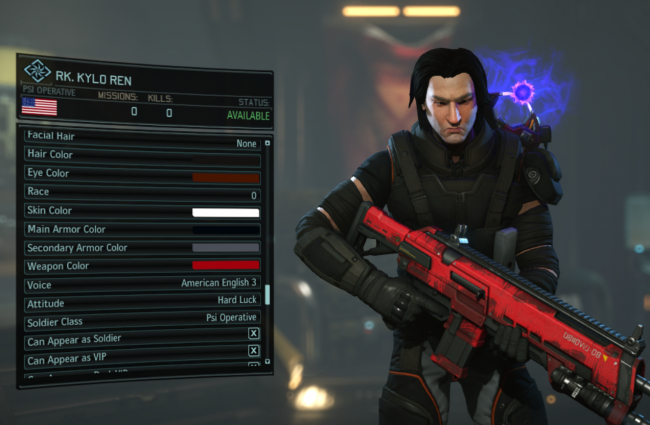
PCGamer capturing Kylo Ren and his, “I just ate a lemon” expression perfectly
As with EU and EW, you have to balance expansion of your base with careful shepherding of the limited resources at your disposal
These custom-created characters all go into the pool. During missions these characters are drawn from the pool at random as recruits in the Armory or rewards for completing missions. Thus, you cannot, unless you create possibly hundreds of characters, pick an all Force Awakens team.
Overall, the design and aesthetics are very much the same as the EU and EW with minor incremental improvements.
Gameplay
Gameplay can be broken into two distinct areas, both equally important to your eventual success or failure. First, we have the base management game. The first thing you will notice is that your base is mobile. The Avenger is a captured alien vessel, with many areas blocked off as XCOM does not have the resources to fully clear the decks of all the alien junk.
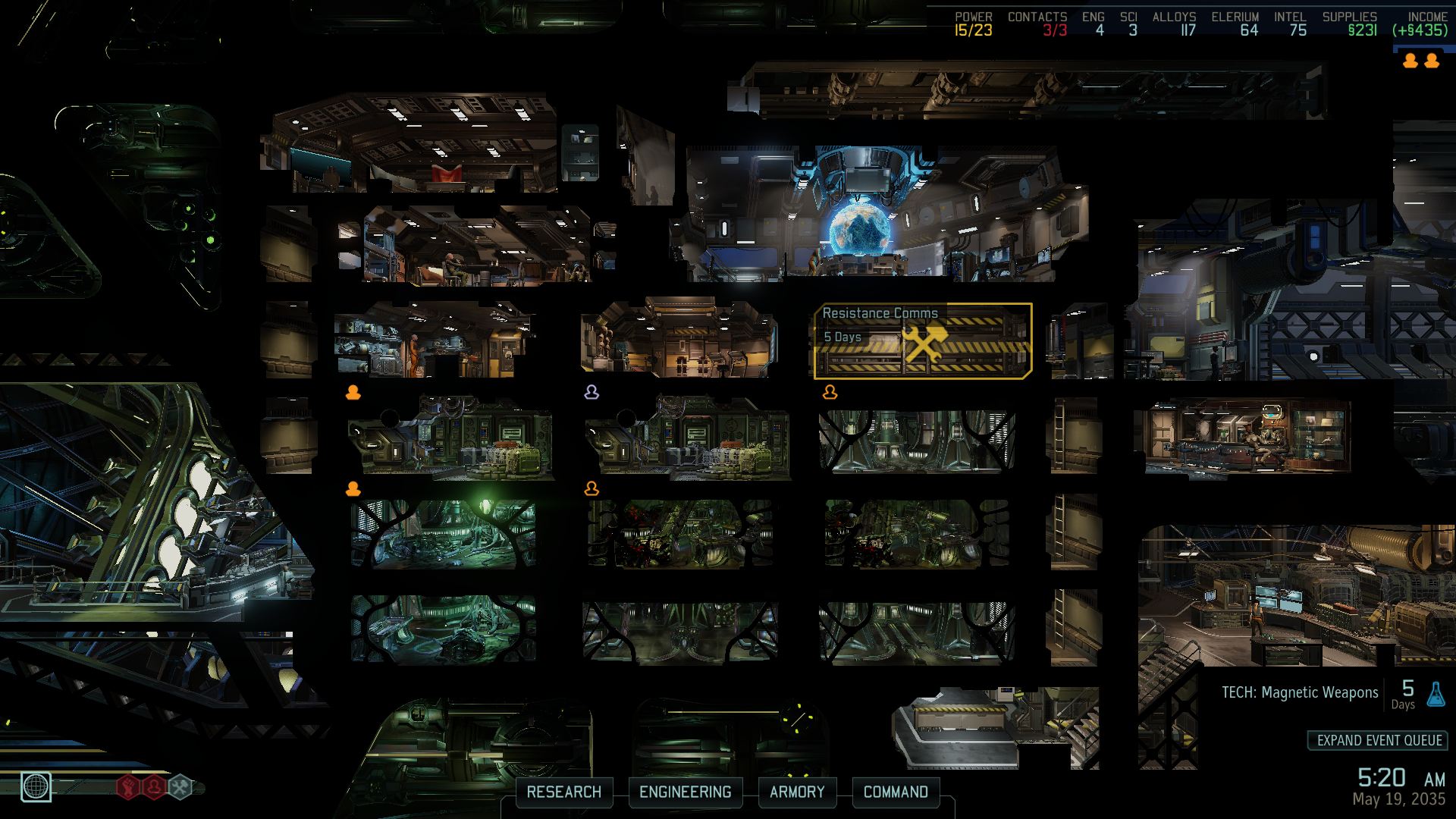
Your new mobile base, complete with Alien junk.
As with EU and EW, you have to balance expansion of your base with careful shepherding of the limited resources at your disposal, made even more so now as you do not have governmental support any longer. Carefully balancing your need to expand labs to research more effective weapons and armour with the need to build more communications rooms, and more power conduits to power all this, leads to agonising decisions over which is more important. Additionally, you are also faced with choosing which areas of research are key to your survival and, hopefully, success. The new Plasma Gun is sexy as hell, but the information spike that gains you insight and intel when used on Advent Officers can be more valuable in the long run. Then again, that new armour may be the difference between your newly promoted and very valuable Colonel Ranger coming back wounded or in a body bag. Each decision you make here has a benefit and a consequence, ignoring the research early on will come back and bite you when your team is poorly equipped in battle, but prioritising weapons research can mean that you forfeit communications relays and contact rebel cells too late to stop Avatar. There is no “right” way to play the game, each decision just has a consequence and how you adapt to that is where the skill comes into play.
Part of the base management game is the world map “mini-game”. This activity has you flying around the map taking up random missions to score intel, engineers, scientists and, very rarely, new military recruits. The most important aspect of this part of the game is to make contact with the rebel cells around the world to open up missions in other parts of the world that move the story forward and allow you to uncover the mystery behind Avatar.
A nice feature is that now when you drop into a map, the enemy doesn’t automatically know you are on the field.
The second part of this game is, of course, the battle sequences. Again you take tactical command of an initial team of four rookies who, through combat, earn promotions, specialisations and, with each rank, a unique ability. As is traditional, battles are turn-based, with each character having a specific number of tiles that they can move or actions they can take. Move within the blue grid and you have another action available, be it another movement, attack, or the ability to go into Overwatch. Sprint to the edge of the Orange grid and all actions for that turn are used up. For players like me, moving to the blue areas and going into Overwatch each turn (the slow and steady approach) is probably the best way to ensure everyone survives. However, this can lead to you losing loot drops that self-destruct within three turns, or even failing a timed mission as the clock ticks down. On the other hand, sprinting willy nilly into a situation can lead to your team being poorly positioned, and quickly dying. The safest bet seems to be to use the first turn to sprint ahead and then to carefully pick your way forward to the first encounter.
A nice feature is that now when you drop into a map, the enemy doesn’t automatically know you are on the field. Instead, the group is concealed, unless they move through a red highlighted square, representing the enemy’s line of sight, or until they initiate combat. One word of warning, if one teammate is spotted, the rest lose their concealment as well. This allows you to carefully watch the enemy for patrol patterns and to set up an ambush using Overwatch. Overwatch has also been improved: if you have more than one soldier in Overwatch, they will open fire in turn and not at once, thus ensuring that should your first soldier kill an enemy, your other guys will remain in Overwatch until the next turn or until triggered. This new Overwatch and Concealment mechanic is insanely difficult to set up as I have often been caught midway through positioning, but when you do get it right, it is immensely satisfying to see all enemies fall to carefully timed shots.
The enemy sightline feature, though, is not perfect. I have had instances when my troops have been above the enemy on a roof behind cover, and when the enemy turn starts and they move on their patrol pattern, they somehow spot my soldiers, and in turn ruin my ambush. This can be very frustrating. An additional frustration is that early on, many missions are on a timer. If you do not complete an objective within a certain number of turns, you will fail and lose access to whatever you were after for that mission. The loss of this intel or resource doesn’t immediately lead to a “Game Over”, but you certainly are at a disadvantage early on and have a higher possibility of ending the game as a failure. This makes the initial missions more difficult than need be, but later in the game reduces the tension as you are so used to the mechanic that you know exactly how to approach the mission to ensure you win. It is a cheap mechanic when deployed early, and a pointless one later in the game.

Cheap timers should only be on cheap watches
The game does a very good job of introducing enemies. You start off fighting Advent Soldiers and Officers, basically alien augmented humans with little health and skill. Soon though, you are introduced to the Sectoid and with it, comes its annoying Zombie Resurrection ability and the Viper enemy with its soul crushing habit of grabbing your soldier from cover 5 squares away. This forces you to prioritise killing these enemies first while still keeping an eye on the lesser foes. Once Mutons, the Faceless, and the rest of the high powered aliens are introduced, you will be jumping every time you see an alien or a civilian milling about. The Faceless are particularly worrisome, as they look like normal humans until they reveal themselves in the middle of an intense firefight.
In terms of firefights, not much has changed here: move into cover, look for enemies, and try and set up ambushes and flanking tactics. What also hasn’t changed, unfortunately, is that combat is basically a dice roll game, relying on probabilities. Each time you click on an enemy to shoot at it, a percentage is displayed, representing the chance of success. You will spend time flanking and getting into what looks like good cover and firing position, to find that your chance of success from three blocks away is only 40%. Your careful manoeuvring has resulted in less than ideal shooting circumstances and forces you to take a chance, not recommended, or go into Overwatch and hope that when the enemy moves you will be able to reduce his health. And even when you have a high-percentage chance of hitting the target, you can still miss. I have had an instance when I had a 78% chance of hitting and still missed the bugger who went on to kill one of my team members.
All in all, game play has changed little from EU and EW, but the new improvements are welcome and add more tactical options to the game.
Technical Difficulties
The game has, unfortunately, launched with a host of bugs and issues. This is not something that is easy to understand since it was delayed for around three months from November to February, and because it is a PC exclusive. I have not experienced any game-breaking bugs, but the game is not optimised at all, producing graphical glitches and framerate drops. Using the recommended game specs for my machine, frame rates would often drop as low as ten or into the single digits. Turning off most graphical options, such as anti-aliasing and draw distance, has enabled me to achieve 60FPS, but not consistently as it will still often drop to between 30 and 40 FPS in game. Optimisation is so poor that the sound in pre-rendered cutscenes is noticeably out of sync.
I have read of severe bugs making Iron Man runs impossible and inadvisable. Firaxis have stated that they are working on patches, but this is par for the course with the terrible state that we find games in today on release. This is by no means a debacle on the level of Arkham Knight, but it is not an encouraging state of affairs either.
Mods
The game has shipped with immediate support for Steam Workshop. In fact, Firaxis hired the team behind the excellent Long War mod for EU and EW and they released three mods on launch. Within the first weekend of release there were at least 60 fan mods available. Most are simple cosmetic mods such as new nation flags, Star Wars helmets, and new colours. There are some that improve gameplay, such as the mod allowing you to save time by using a one button press to put all characters with remaining actions into Overwatch. Community support like this will extend the life of the game and make improvements to the base game over time.
Conclusion
Despite the sub-par optimisation, this is a game for all fans of XCOM and turn based strategy. There is enough for experienced players to feel challenged and keep them happy, while the difficulty will be sufficient to challenge newcomers without chasing them away after a few missions.
Systems Specifications
CPU: Intel i7 – 4770 @3.40GHz
GPU: nVidia Geforce GTX 670
RAM: 16GB DDR3 (2400MHz)
OS: Windows 10 Enterprise


Please login to post comments.
More Reviews

Review: Elden Ring: Tarnished Edition (Switch 2)
What can I say about Elden Ring that hasn’t already been said? From Software’s magnum opus originally...
21-09-26 Read more
Review: The Blood Of Dawnwalker
Rebel Wolves’s The Blood of Dawnwalker has often been compared to The Witcher III: Wild Hunt from fellow...
15-09-26 Read more
Review: Marvel's Wolverine
When I think about some of PlayStation Studios’ most consistent developers, Insomniac Games always ranks...
10-09-26 Read more
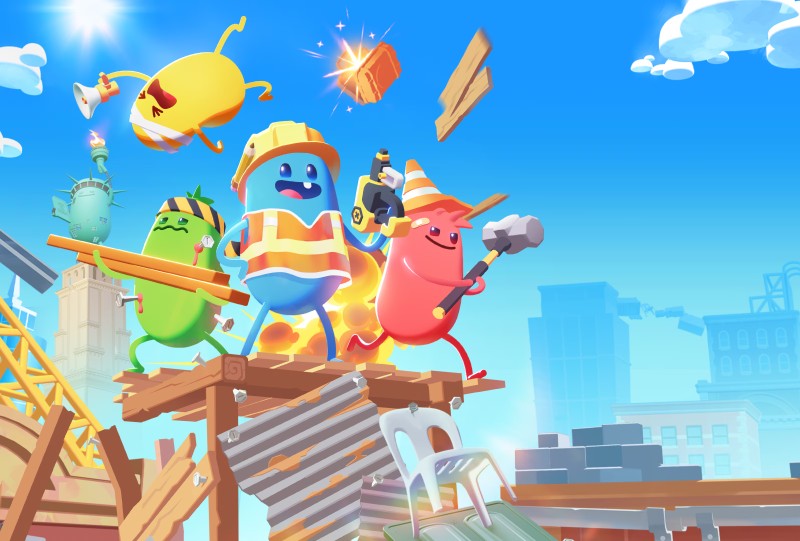
Review: Dumb Ways to Build
Originally a public service announcement which discouraged the Australian public from thoughtless activity...
09-09-26 Read more
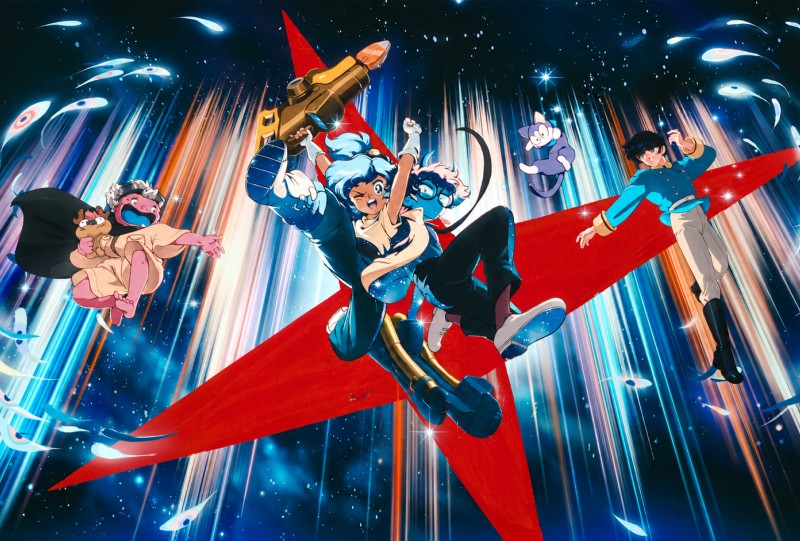
Review: Orbitals
Booting up Orbitals for the first time, I was immediately hit by a warm wave of nostalgia like the food...
08-09-26 Read more

Review: Onimusha: Way of the Sword
It’s a good year to be a fan of action games, and an even better year to be a fan of Capcom. After delivering...
31-08-26 Read more

Review: Spa Weekend
I was invited to attend an exclusive preview screening of the film Spa Weekend on August 20th at Sandton...
21-08-26 Read more
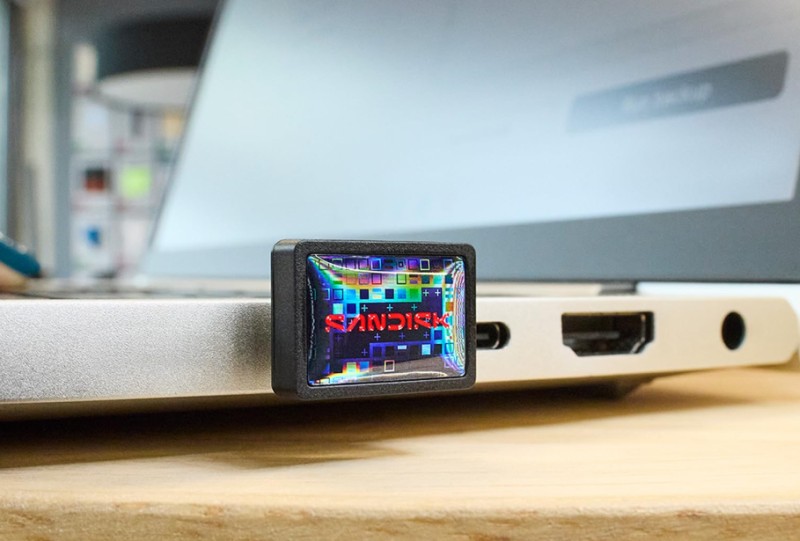
Review: SanDisk Extreme Fit USB-C Flash Drive (128GB)
The SANDISK Extreme Fit USB-C™ Flash Drive - 128GB is something that you might not even believe exists...
21-08-26 Read more
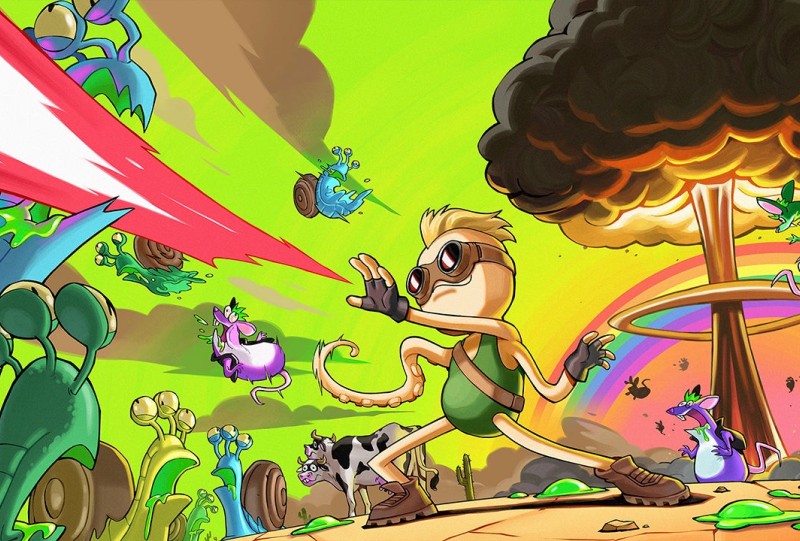
Review: Ground Zero Hero
It’s not often that a game comes around with the ability to grip you into a mindless cycle of absolute...
19-08-26 Read more
Review: Marvel Tokon: Fighting Souls
You know, if anybody was going to make a Marvel themed arcade fighting game in 2026, I’m glad Arc System...
18-08-26 Read more

Overview