Latest Updates
Who's Online

Please sign in to add comments

Cart Contents
| Item: | Price: | Qty: |
|---|---|---|
| Total: R 0.00 | ||
User Content
Latest Poll
Review
Review: This is the President
Political baggage.

This is the President - developed by SuperPAC and published by THQ Nordic - describes itself as a “story driven management game”. It’s a fair description as while player-choice and management systems dominate the experience, there are strong story-driven elements that dictate the pacing. The problem is these story beats feel simultaneously refreshing and intrusive in this genre, while too much randomness makes thoughtful player-choice just feel like a coin toss.
This is the President begins with a comic-book style cutscene – used throughout the game during key events – in which a prisoner tries to convince a guard to grant him access to a phone. He supposedly has information on the current president of the USA he needs to leak to the world, to save America. Events jump back in time to the player character’s nomination speech, giving you your first taste of the user interface and choice-based gameplay, as you compose a speech and make promises you may or may not be able to keep.

To reiterate, This is the President is not a pure political sim. Sure, you spend your time making choices that balance your available budget against political machinations and events that could swing public popularity, but it’s more of a satirical visual-novel experience, in which the story dominates. Your character has a predefined history that influences the entire game and they’re not just slightly compromised, nor are they heavily compromised – they’re compromised to such a farcical degree I doubt they achieved anything in life without resorting to criminality. Of course, this sordid past makes for some great gameplay scenarios.
Your character has a predefined history that influences the entire game and they’re not just slightly compromised.
Once you start making decisions – think picking policies, responses during press briefings, and dictating team member actions – there’s plenty of dynamic feedback that’s wonderfully presented. This can take the form of press articles from left, centrist, or right-leaning outlets; graphs showing your budget and popularity swings; the burnout of team members and their requests for expensive treatment or greater salaries; or the backlash from an entrenched political establishment that knows full well what you’re trying to achieve.

Your ultimate goal (along with that of your “first lady”) is to pass an amendment to the constitution – “Amendment 28”. An amendment that would prevent sitting and former presidents from being prosecuted, for life. The problem is convincing congress, swinging the balance of the Supreme Court in your favour, and obtaining a never-before-seen 90% popular vote. Needless to say, playing it clean is not going to be an option. Financing dodgy deals form a big part of your overarching goals and, to make matters worse, your past keeps catching up with you in unexpected ways.
The downside to this structure is key narrative moments during your 4-year journey – which plays out on a month-by-month basis, with mandatory and optional event cards – always occur, irrespective of your prior actions and current standing. It allows the story to take some wild and often nonsensical turns, but it also undermines the impact of other choice-driven moments and makes the act of tackling secondary event cards feel shallow.
The characters you interact with – be that your team, other world leaders, lobby groups, and even former lovers – feel absurdly diverse and always provide entertaining scenarios.
On the upside, the writing is solid – essential in a game in which the bulk of your time is spent reading. The characters you interact with – be that your team, other world leaders, lobby groups, and even former lovers – feel absurdly diverse and always provide entertaining scenarios. Satire is the name of the game, sometimes uncomfortably close to reality, and SuperPAC has done a great job playing on both historical and modern political hypocrisy. There are politicians fully aware of your goals but will support you to save their own skins; media groups so biased they might as well be directly funded by political parties; internal factions with their own agendas; irrational public interest groups; and insincere social media initiatives.
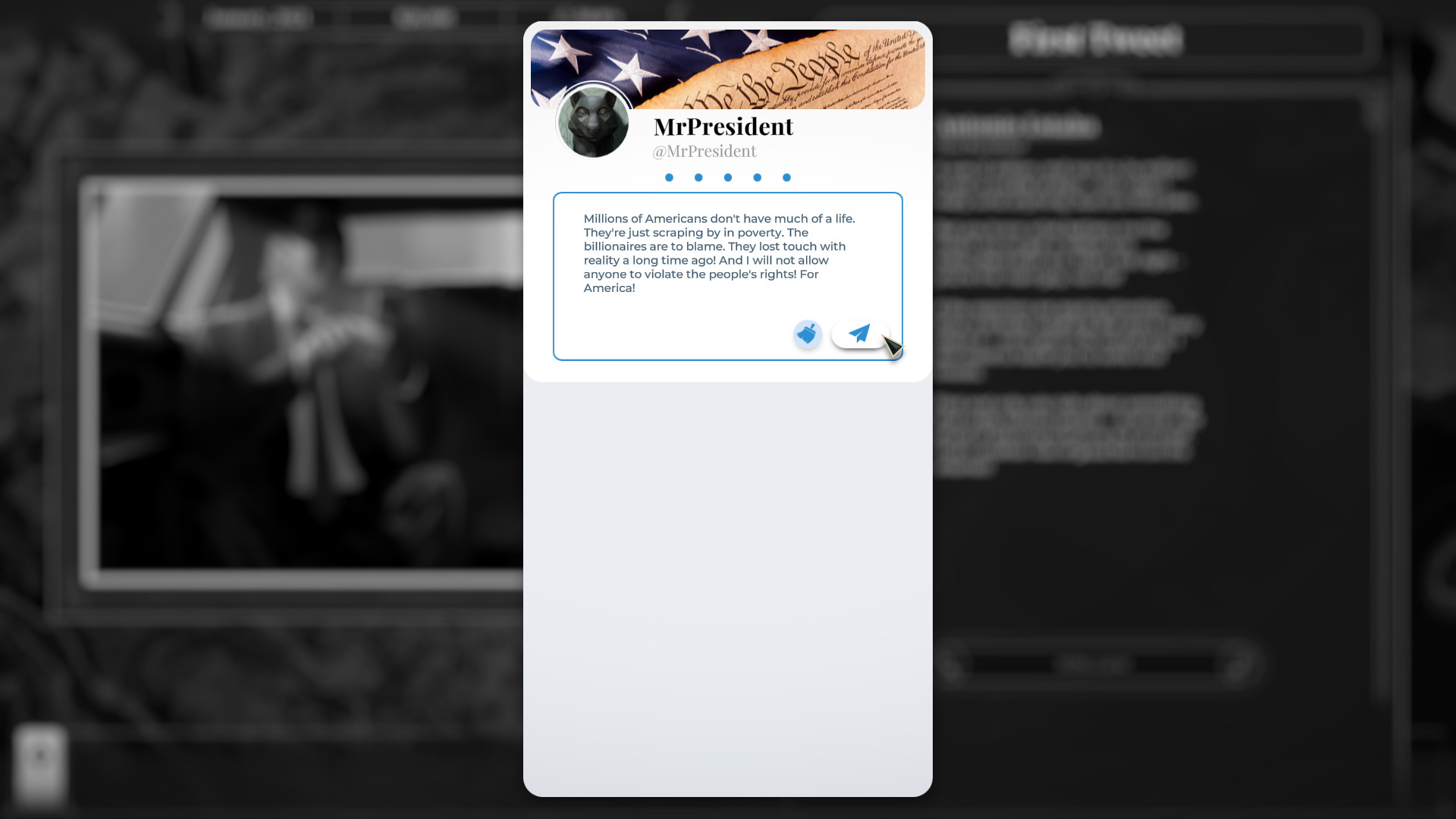
The visual-novel structure, paired with management elements, results in gameplay that feels simplistic but is surprisingly engaging and addictive. A mouse and the ability to click are all you’ll need to navigate your political career. Naturally, there are various submenus to parse, talking heads, visual flourishes, and audio cues to spice up the experience, but reading and clicking on choices is the bulk of the experience.
Thankfully, those simple acts are made more compelling by the need to assess each situation, decide on which team members to assign to the task, ponder over their suggestions (and whether it’s worth burning them out for short-term gain), then commit to a decision. There’s no traditional save-scumming, only one continuous autosave and the option to roll back to the start of a month, so the stakes feel suitably high.
This is the President gives the “protagonist” so much baggage that the story-driven elements dictate so much of the experience.
Deciding on which policies to sign, weighing up appropriate response to press enquiries, deciding when to fork out cash for unexpected expenses (or opportunities), deciding who to court for funding, choosing which world leaders to support or antagonize – it all sounds great in principle and would work well in a pure political sim with a blank-slate character and pure-choice driven outcomes. However, This is the President gives the “protagonist” so much baggage that the story-driven elements dictate so much of the experience, while the randomness of so many outcomes left me less engaged the longer I played.

Story beats, although surprising and entertaining – and often coupled with several hilarious cutscenes – swiftly reveal themselves to be the most important decision-making moments. These are usually related to the president’s shady past and teach you the subtle approach is not always viable. Hell, one early event has only one viable outcome and the game will push you into it, even if you exhaust all other options. From a narrative perspective, it’s a great setup for things to come; from a gameplay perspective, it feels restrictive.
These story beats, which often impose time limits and financial requirements, are key to achieving your core objectives required to pass Amendment 28. Politicians, judges, and donors need swaying, and your options are limited. Cold hard cash and blackmail evidence are the tools you use to influence them and build an effective team. Despite optional event cards becoming more prevalent as your career progresses – and the map expanding to encompass an entire globe of sleazy leaders – you’ll soon realize they exist almost exclusively to shift popularity up and down by incremental amounts or obtain once-off funding.
One early event has only one viable outcome and the game will push you into it, even if you exhaust all other options.
While that may sound appropriate given your final goal to achieve 90% of the popular vote, wildly inconsistent outcomes and gameplay systems are designed to keep your popularity middling, until you can pass a flurry of key policies or executive orders in your final year of power.

The biggest problem is how utterly random events feel. You could successfully discredit an opponent with a social media campaign in one event, only to have the press calling you out for it in the next event, then find it works again in a subsequent scenario. Picking the team member with the right skills can guarantee “better” outcomes but, even using the same approach with the same specialist team member could produce wildly different results.
Another issue is how popularity shifts are more severe at higher (and lower) popularity levels. Throw in the aforementioned randomness and it feels like you’re constantly being pushed back to the middle, leaving you without options except for story-driven events and implementing major policies.
This is the President crashed on me every other session (and this is after three post-launch patches).
The final impediment to my progress was a technical one and perhaps this will only affect certain hardware configurations. Despite the relatively simple presentation, slow-paced gameplay, and low system requirements, This is the President crashed on me every other session (and this is after three post-launch patches). The game is consistent about autosaving between events, but I often had to repeat lengthy, multi-choice scenarios and even experienced crashes that locked up my PC to the point I had to power cycle - a rare feat these days.
When you combine all these issues, tackling monthly events felt increasingly frustrating rather than entertaining. I was happy to break immersion, disengage with most optional activities, and just focus on preserving my team and budget for story events, funding opportunities, and major milestones.
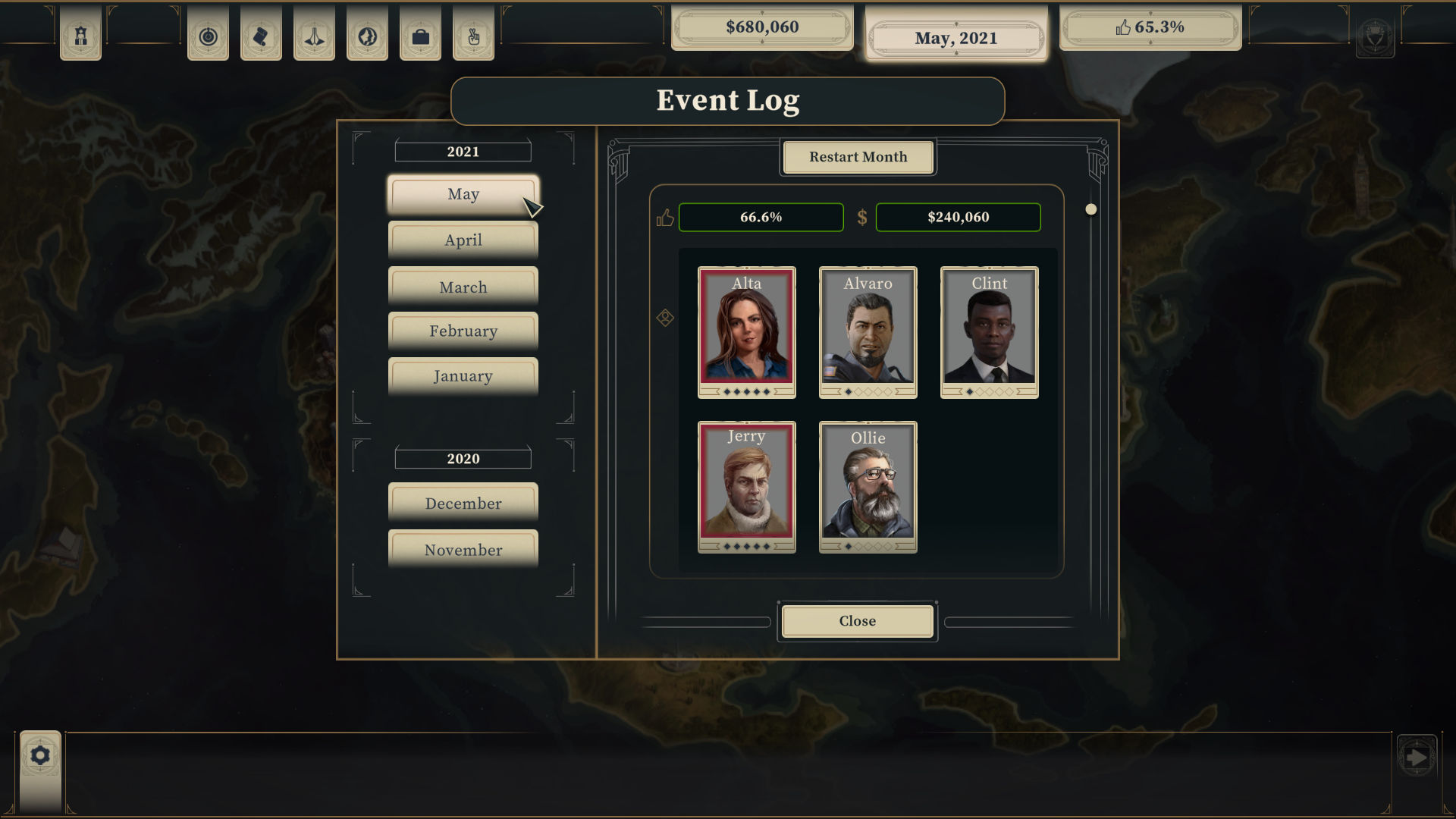
Now, despite describing the presentation as simple, it’s by no means bad. The general interface, overview map on which you select event cards, and the cards themselves, feel slick. All elements feature stylised artwork, simple animations, and appropriate audio cues for feedback. Immersive ambient audio is used during several encounters to add more life to the mostly static artwork and text, while several cutscenes are fully voiced for added impact (with suitably cheesy voice acting). The music is a highlight, with smooth or high-tempo jazz tracks as you navigate your monthly tasks, riffs on traditional ceremonial pieces for major events, and a few original spoofs. I expected the limited presentation would become problematic given the lengthy playtime, but smart design choices prevent interactions from feeling stale over time.
Overall, This is the President is an engaging take on the typical management sim genre, with a strong focus on story-driven elements, that manages to charm and frustrate in equal measure. The story-driven elements serve to both elevate and detract from the overall experience. With a “president” so ridiculously compromised, there’s no shortage of interesting events over their 4-year term. However, the story-driven focus – along with other design choices – result in optional events and management elements feeling either too random or ultimately unimportant. Additionally, while the smart and effective presentation coupled with sharp writing will keep you pushing forward, a non-stop barrage of satire begins to feel one-note over the lengthy 15+ hour playthrough.


Please login to post comments.
More Reviews

Review: Elden Ring: Tarnished Edition (Switch 2)
What can I say about Elden Ring that hasn’t already been said? From Software’s magnum opus originally...
21-09-26 Read more
Review: The Blood Of Dawnwalker
Rebel Wolves’s The Blood of Dawnwalker has often been compared to The Witcher III: Wild Hunt from fellow...
15-09-26 Read more
Review: Marvel's Wolverine
When I think about some of PlayStation Studios’ most consistent developers, Insomniac Games always ranks...
10-09-26 Read more
Review: Dumb Ways to Build
Originally a public service announcement which discouraged the Australian public from thoughtless activity...
09-09-26 Read more

Review: Orbitals
Booting up Orbitals for the first time, I was immediately hit by a warm wave of nostalgia like the food...
08-09-26 Read more

Review: Onimusha: Way of the Sword
It’s a good year to be a fan of action games, and an even better year to be a fan of Capcom. After delivering...
31-08-26 Read more

Review: Spa Weekend
I was invited to attend an exclusive preview screening of the film Spa Weekend on August 20th at Sandton...
21-08-26 Read more
Review: SanDisk Extreme Fit USB-C Flash Drive (128GB)
The SANDISK Extreme Fit USB-C™ Flash Drive - 128GB is something that you might not even believe exists...
21-08-26 Read more
Review: Ground Zero Hero
It’s not often that a game comes around with the ability to grip you into a mindless cycle of absolute...
19-08-26 Read more
Review: Marvel Tokon: Fighting Souls
You know, if anybody was going to make a Marvel themed arcade fighting game in 2026, I’m glad Arc System...
18-08-26 Read more

Overview
Developer
SuperPAC
Publisher
THQ Nordic
Platform
PC
Release date
6 December 2021