Latest Updates
Who's Online

Please sign in to add comments
 )
) 
Cart Contents
| Item: | Price: | Qty: |
|---|---|---|
| Total: R 0.00 | ||
User Content
Latest Poll
Review
Review: Immortals of Aveum
You're a Magnus, Jak.

Everybody loves a good tale of epic adventure, the emergence of an unlikely hero from within a world torn apart by conflict who perseveres through seemingly endless hardships, seeking an almost impossible victory. With everything they hold dear slowly spiralling into chaos around them, our champion may either succumb to absolute despair, or opt for a considerably more positive outlook and reckless course of action – often making no sense and aggravating their superiors to no end. Like Jak from Immortals of Aveum.
Unnecessarily long-winded introduction aside, I’ll start off by stating that I had a lot of fun playing Immortals of Aveum – more than I was expecting, to be perfectly honest. Developed by Ascendant Studios, the talented team birthed by former Dead Space and Call of Duty (under Sledgehammer Games) creative director, Bret Robbins, and published by Electronic Arts (the EA Originals banner, specifically), the title sees you control the aforementioned Jak as he is recruited into the prestigious ranks of the Immortals after suddenly awakening to his true magical potential in the aftermath of an enormously emotional series of events. As you might expect, there is a lot to unpack here, so bear with me.

The Immortals are the frontline battlemages (or Magni) of Lucium, one of the five realms comprising the lands of Aveum, a world where some are born with more magical aptitude than others. The only other realm comparable in size and manpower to Lucium is Rasharn, led by the power-hungry Sandrakk. These two zones are the main participants in what is known as the Everwar – a perpetual power struggle over magic and the leylines that circulate it across the land. And that’s just the tip of the iceberg. As Jak’s story unfolds - from the bleak walkways of Seren, to Lucium and beyond - he’ll uncover more than he bargained for, including the secrets of the Order of the Immortals and the nature of the Wound, an ever-expanding chasm at the heart of Aveum.
I had a lot of fun playing Immortals of Aveum – more than I was expecting, to be perfectly honest.
Without diving too far into the story and spoiler territory, the universe Ascendant has constructed here is quite impressive and believable - the diversity and detail in Aveum’s scenery goes a long way in not only holding your interest throughout the plot but heightening immersion. Immortals of Aveum was developed in Unreal Engine 5.1, and we have that to thank for the visual fidelity on display here. You really do feel like you’re stepping into a war-torn world with its own extensive history, one that never feels like it owes an explanation to you as the player.

The major downside of this comes in the form of an absolute deluge of names, places, and terminologies that’ll have you clinging to the in-game lore journal for dear life. There are instances of investigative dialogue options popping up every now and then (some timed), but more often than not the real juicy information comes from the lore entry immediately unlocked after the conversation ends. The story certainly gets easier to follow the further into the game you get, but I can see a lot of people’s eyes eventually glazing over, focusing instead on the combat and actual gameplay. Which is totally understandable, given how satisfying they are.
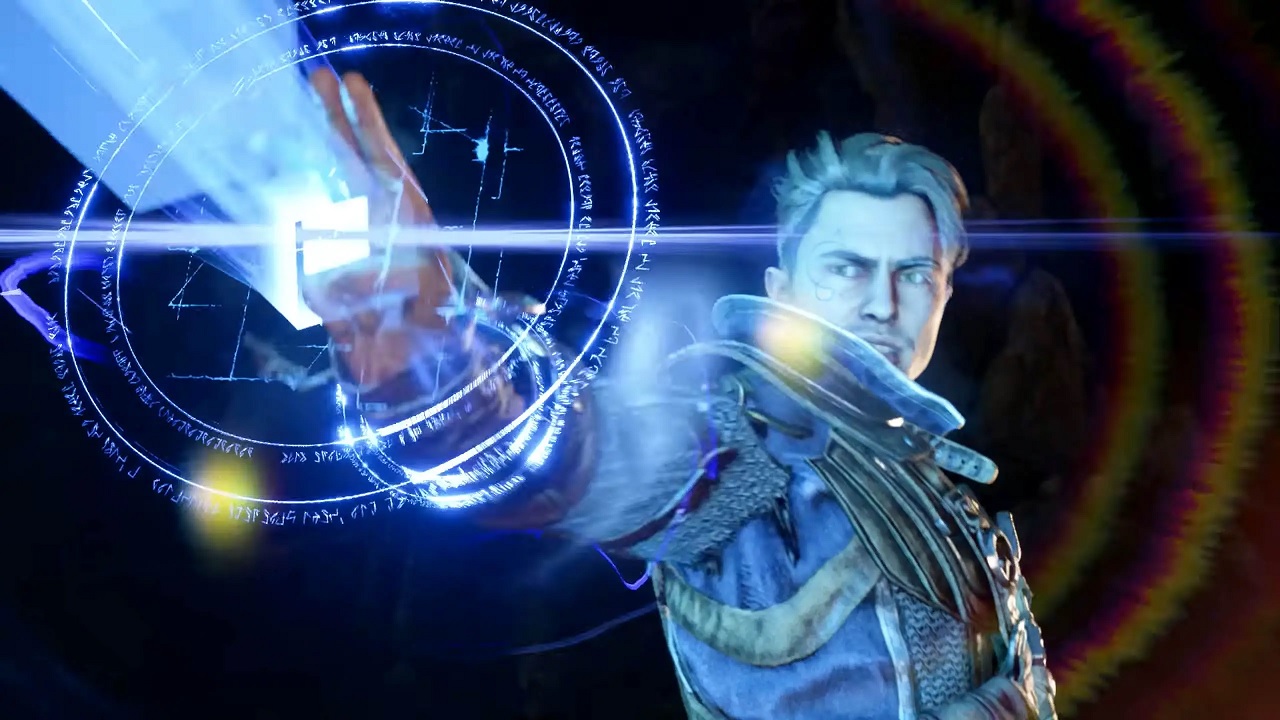
Immortals of Aveum’s battle magic behaves more like traditional firearms than your standard fare RPG spells and is a perfect fit for its first-person perspective. As a Triarch, Jak is able to wield all three types of offensive and defensive magic. Creatively dubbed Blue, Red, and Green Magic, each colour has its own use in and outside of combat and appear in various forms for both Sigils and Totems. Allow me to explain. Sigils are devices employed when casting basic attack spells, or Strikes, and are equipped to Jak’s right hand. Totems provide additional arcane utility and are cast from Jak’s left hand. Every colour of magic has three Strike types (some objectively better than others) that affect how your attacks manifest, and every Sigil will host only one. Confused? Good.

Blue Strikes focus on powerful long-range magic shots, Red Strikes are primarily used for close-up damage bursts, and Green Strikes provide rapid-fire projectiles that typically lock onto nearby enemies. Totems focus on Control spells and can make dealing with foes less of a headache. The Control spell Lash, for example, can be used to pull enemies towards you before blowing them away with a Red Strike, or employed as a grappling hook allowing you to swing across large gaps in the terrain. Limpets, meanwhile, slow enemies down significantly, giving you some space to breathe. If you’re in need of more powerful Sigils or Totem variants, equipment can be crafted or upgraded at any of the forges around Aveum with looted gold and elemental essence, or deconstructed for more resources. Confusion subsiding? I hope so.
It’s a real treat sprinting around during battles and using every tool at your disposal, especially during one of the many boss encounters.
If the Strikes and Totems weren’t enough for you, powerful Mana-consuming special attacks known as Furies can make short work of larger enemy groups, while your ultimate Dominion beam ability channels the full force of all three colours of magic for huge damage output. It’s a real treat sprinting around during battles and using every tool at your disposal, especially during one of the many boss encounters. These fights are always enjoyable and suitably epic in nature, with victory usually awarding you with powerful gear or upgrades to either health or Mana.

Defeating foes is one way of obtaining Arcanum, a substance that slowly fills up the Ascension bar. For every completed bar, points that can be spent on acquiring new abilities or talents (around 80 in total) are granted. Split between the primary magic colours, you can either focus on specialising in one skill tree or all three. Some talents do require investments in other colours before becoming unlockable, however.
Once you’ve emerged from a taxing fight, you’d be wise to spend some time exploring the world around you. While story progress is fairly linear, there are plenty of smaller side areas waiting to be discovered along the way containing gold chests, new items (if crafting isn’t a viable option due to low ingredients, somehow), and Shroudfanes (challenges that unlock abilities or upgrades). Every area is just large enough to encourage wandering off the beaten path and features a healthy amount of environmental puzzles to solve.

Typically, these require the usage of an Augment to access, spells that enable Jak to (among other things) reach previously inaccessible parts of the map – like hovering between platforms too far apart to accommodate basic jumping or moving objects in the environment to suit your needs. The puzzles themselves usually involve finding a combination of nearby blue, red, or green gems and zapping them with the appropriate Strike to progress, but there are definitely exceptions to this basic formula. The side content also relies on some surprisingly great first-person platforming sections, although unlocking the Hover Augment does render most of them trivial.
Every area is just large enough to encourage wandering off the beaten path and features a healthy amount of environmental puzzles to solve.
During your runs between objectives, you’ll inevitably bump into what is perhaps the biggest issue I have with Immortals of Aveum – its inconsistent framerate. Felt mostly in areas like Lucium, and seemingly mainly affected by plant life and moderate to high-intensity action sequences, it can be a real distraction for those out there who go nuts for anything below a smooth 60 frames per second - on consoles, at least. It never drops to anything truly awful, and some regions are much better off than others, but it is very noticeable and a huge no-no for first-person shooters.

Another potential source of frustration, switching between Sigils is not done using a selection wheel and instead has to be manually cycled through. This isn’t too bad, in all honesty, as there are only three options (one for each magic colour), and you don’t have to wait for any animations to play out before cycling between Strikes. If I know my Green Magic Sigil is two cycles away, I can rapidly push the cycle button twice and I’ll have it equipped. This also adds to the frenetic nature of combat - quickly switching from blue to red, from red to green, and back to blue, all while firing off Furies and blinking out of incoming attacks really gets the adrenaline pumping.
Jak’s dialogue is, thankfully, nowhere near as bad as some early impressions made it out to be – even if he does come across as gratingly idealistic every so often.
Other minor gripes include flickering shadows, no gamma adjustment setting, annoying motion blur in cutscenes, and, as previously detailed, the initial confusion that permeates the first couple of chapters of the main storyline as a result of the early speedy plot pacing and dumping of exposition. Jak’s dialogue is, thankfully, nowhere near as bad as some early impressions made it out to be – even if he does come across as gratingly idealistic every so often. That said, be prepared for some strained attempts at comedy from both the main and supporting cast. There’s one memorable moment around halfway through the story that stands out in a big way that I won’t spoil. You’ll know exactly what I’m talking about when you see it for yourself.
It’s a real testament to how much of a punch the combat packs that most of these lesser flaws fall to the wayside when you’re out there in the field blasting away at any number of hostiles pulled from the game’s impressive enemy roster. This is also one of those supremely rare occurrences where a game’s default controller set-up doesn’t need too much tweaking, aside from a slight sensitivity boost, perhaps. Your mileage may vary, of course.
Immortals of Aveum, while not exactly doing anything revolutionary in the grand scheme of things, is still a good time. The original setting, core gameplay, and solid combat mechanics are the true stars here, outshining the few issues threatening to put a damper on the overall experience – many of which will likely be addressed in the day one patch. If you’re looking for another FPS fix with a fantasy twist and an emphasis on world-building, I’d say go for it.
*PS5 Review code provided by Electronic Arts | Reviewed by Ryan Pretorius


Please login to post comments.
More Reviews

Review: Pixel Washer (Early Access)
There’s always something uniquely satisfying about games that’s sole focus is on making something that...
14-10-26 Read more
Review: Hellraiser: Revival
I’ve been a fan of the Hellraiser movies ever since I snuck a VHS rental (yeah, remember those?) of ...
13-10-26 Read more
Review: The Sinking City 2
The Sinking City 2, from Ukrainian developer Frogwares, is less of a sequel than it is a Lovecraftian...
12-10-26 Read more

Review: Fire Emblem: Fortune's Weave
It’s legitimately very hard to believe that it’s been seven whole years since Fire Emblem: Three Houses...
05-10-26 Read more
Review: Control Resonant
It’s been seven years since the events of developer Remedy Entertainment’s original 2019 Control title...
02-10-26 Read more

Review: Gears of War: E-Day
Xbox’s flagship Gears of War series has had a bit of an identity crisis over the last decade. After ...
01-10-26 Read more

Review: Gachiakuta
Gachiakuta took the world by storm when it first aired from July to December 2025. With its gritty animation...
28-09-26 Read more

Review: Elden Ring: Tarnished Edition (Switch 2)
What can I say about Elden Ring that hasn’t already been said? From Software’s magnum opus originally...
21-09-26 Read more
Review: The Blood Of Dawnwalker
Rebel Wolves’s The Blood of Dawnwalker has often been compared to The Witcher III: Wild Hunt from fellow...
15-09-26 Read more
Review: Marvel's Wolverine
When I think about some of PlayStation Studios’ most consistent developers, Insomniac Games always ranks...
10-09-26 Read more

Overview

Add to cart
Developer
Ascendant Studios
Publisher
Electronic Arts
Platform
PC, PlayStation 5, Xbox Series
Release date
22 August 2023