Latest Updates
Who's Online

Please sign in to add comments

Cart Contents
| Item: | Price: | Qty: |
|---|---|---|
| Total: R 0.00 | ||
User Content
Latest Poll
Review
Review: GreedFall: The Dying World
More GreedFall but less accessible.

After rewriting this opening paragraph multiple times over 50 hours of play, I’ve settled on GreedFall: The Dying World as more GreedFall for fans of the original – just with a major caveat that can make or break the experience. It functions as a prequel with an ambitious scope, an even larger cast of interesting characters, more diverse regions to explore, and it is often beautiful and atmospheric. However, it comes with a tweaked combat system and lack of polish reflecting the troubled development period.
I should also admit up front that I have a soft spot for the French developer, going all the way back to 2012’s Of Orcs and Men, despite some recurring flaws. I find Spiders varied and gritty game worlds novel; the weird and awkward characters are more interesting than your typical fantasy or sci-fi cast; and they always strive to offer multiple quest solutions and outcomes despite a limited budget. Those aforementioned flaws are dubious level design with a fondness for maze-like maps - something they’ve mostly resolved, and a combat system that struggles to find a balance between modern action-RPGs and older tactical CRPGs. In that regard, I feel they’ve gone backwards to their detriment.

For context, 2019’s GreedFall was a critical and commercial success for Spiders and felt like a homage to Xbox 360-era BioWare (while they were off trying to salvage the doomed Anthem). There was a strong focus on player choice, frequent talent-checks, unique companion interactions, and diverse outcomes harkening back to the Mass Effect trilogy and first two Dragon Age games. As GreedFall: The Dying World still does more right than wrong, I wanted to start with the positives.
GreedFall: The Dying World still does more right than wrong...
You now play as a Teer Fradean youth on the cusp of completing their training to become a Doneigada; think lore-keeper tasked with preserving balance between people and nature. After a lengthy prologue reintroduces the setting and core mechanics, the party is ambushed, captured, and taken to the mainland of Gascane by members of the Bridge Alliance – a faction that represents classic colonial savagery hidden behind the excuse of progress. You swiftly escape the capital of Olima and begin gathering a diverse crew representing all the major factions as you explore the cities and countryside of the Bridge Alliance territories, the Naut islands, Congregation lands, and Tir Fradi. Your primary goal is to build a coalition against imperialist plotters that aim to both seize power on the continent and decimate the native population of Tir Fradi.
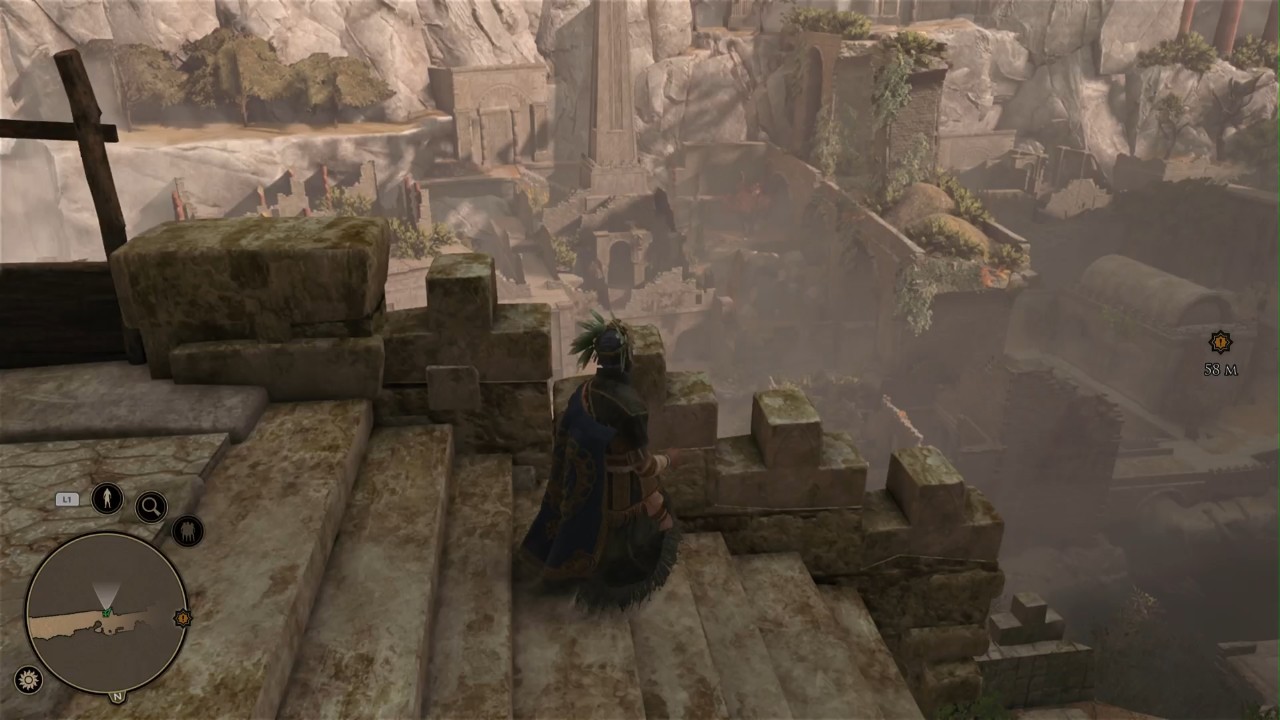
The setup is an improvement over the first game, which relied on establishing a link between the mainland protagonist and the island so they could still do the colonist-goes-native-and-becomes-a-messiah spiel. In GreedFall: The Dying World, your protagonist gets to experience a mix of overt discrimination and condescending fascination from faction leaders and individuals on the continent. Interactions are varied given the needs of the plot or your party composition, but I was impressed at how most factions I courted for support still acted and spoke in a manner that hinted at their underlying self-interest. GreedFall: The Dying World can be played in isolation, but it features key events that transition into the original game without breaking continuity, and it serves to highlight how untrustworthy the colonial powers are unless it suits their immediate needs.
When it comes to questing and roleplaying, Spiders once again ensures choice is present in every quest...
When it comes to questing and roleplaying, Spiders once again ensures choice is present in every quest – even if the gameplay loop and narrative beats might be familiar to RPGs veterans. Once you acquire a ship, you explore large and interconnected zones, with handful of key locations you return to repeatedly and loot chests off the beaten path. You still talk to dozens of NPCs, potentially battle them, recover and deliver items, solve simple environmental puzzles, and use a combination of tracking and talent-checks to investigate. You defeat common bandits, wild animals, and rare named enemies to gain extra XP towards improving attributes, skills, and talents. You loot gear of varied quality and tiers for incremental upgrades, and you harvest an inordinate amount of material for the crafting and alchemy systems.

The foundations may feel commonplace these days but GreedFall: The Dying World hooks you once you realise every quest or interaction has multiple outcomes based on your dialogue choices, talent-checks, who you have in your party, the order you’ve tackled quest objectives, and the outcome of previous quests – major or minor. It’s not always apparent in the opening hours or during a first playthrough, but there is a level of complexity we simply don’t see in modern and big budget RPGs due to prohibitive development costs. Every quest was an opportunity to affect the ending, faction relations, and your companions’ fates.
...there is a level of complexity we simply don’t see in modern and big budget RPGs due to prohibitive development costs.
There are a core sequence of story quests and multi-stage companion quests to work through, but how you reach the conclusion of those quests feels flexible and fluid – even if not quite at the level of Pirahna Bytes’ games like Gothic or ELEX II. Taking a companion linked to the region you’re exploring typically offers unique dialogue options and bonus world-building banter. Using diplomacy checks or bribing guards can offer a way to avoid combat (or potentially infuriate them). The rudimentary but effective stealth and disguise system, coupled with mechanical checks for locks, can get you in and out of areas with key items and evidence with minimal combat. Just exploring thoroughly yields benefits like additional clues, optional items, and new dialogue prompts as a result. My only critique is that talent-checks are now percentage-chance-based rather than hard limits, so save-scumming for the best outcome is tempting.

The quest system in GreedFall: The Dying World is not perfect however and serves to highlight an overall lack of polish. There is the odd dialogue inconsistency (usually around names, gender, or the order of events); there might be lingering objective markers on the map until the quest is fully resolved; and there can be fade-to-black scenes or sudden location jumps that make some quests feel rushed. There’s an obvious trade-off between quest complexity and spectacle, with a handful of notable cutscenes reserved for key moments, and the bulk of your adventure feeling surprisingly low key. For me, it was the right choice, but GreedFall: The Dying World can feel like an adventure in which you work tirelessly in the background to ensure things don’t get worse than they already are.
There’s an obvious trade-off between quest complexity and spectacle...
All of which brings me to the combat. In 2019, GreedFall offered real-time combat – think timed strikes, pistol shots, dodges, and parries – but you could bring up a tactical layer to pause the game, trigger companion abilities, and direct them at specific targets. On the default difficulty, your companions could hold their own so you could focus on exploration and role-playing. In contrast, GreedFall: The Dying World shifts to pure real-time-with-pause (RTwP) combat, and it really hurts the experience if you go in with expectations from the first game.
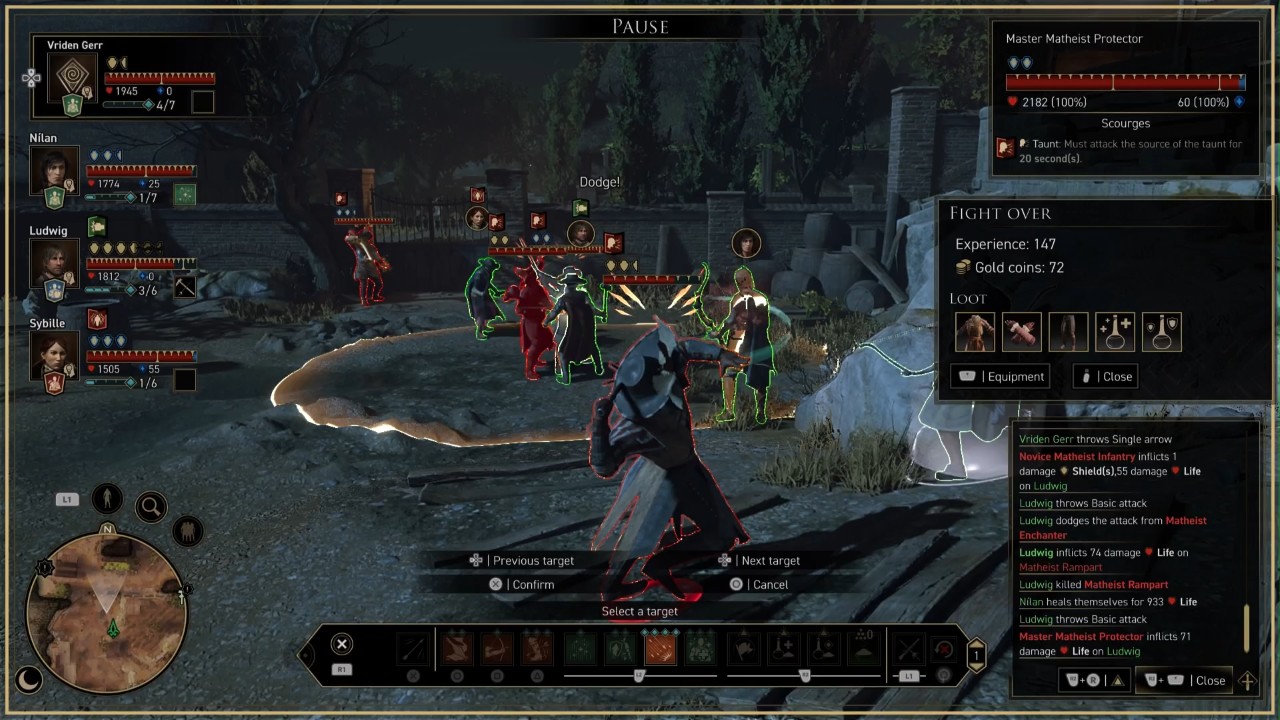
I don’t recall any outcry about the complexity of combat in the first game, so shifting to a more niche system is an odd choice. There is a hybrid toggle that allows your companions to (mostly) manage themselves, but it feels like an afterthought. More problematic is that regardless of your setting, the combat lacks impact as it’s now a pure numbers game. By default, battles are tough, tactical, and tedious. You need to consider positioning and environmental hazards, the use of skills to break armour and magical barriers, and you need to synergise skills with player blessings and enemy curses to inflict meaningful damage.
GreedFall: The Dying World shifts to pure real-time-with-pause (RTwP) combat, and it really hurts the experience if you go in with expectations from the first game.
I don’t doubt there’s a subset of fans happy with this change but my advice (as primarily a console player these days), would be to select custom difficulty, crank up party damage output to 200%, then scale up enemy damage output to your tastes. This resulted in an experience that was challenging enough that I frequently used the RTwP function to assess the situation but, more importantly, it massively improved the pacing so I could get on with the better bits.
There is more I could say about the expanded combat depth that I rarely bothered to explore but, honestly, combat was not a highlight in GreedFall and it was never the reason I was interested in this prequel-sequel. It was the novel setting, the world-building, the diverse cast, the prospect of constant quest choices, and the thrill of watching varied outcomes – all elements that GreedFall: The Dying World still gets right. As such, there is still a lot to enjoy for fans of the first game, but I can’t understand why the game was made less accessible by shifting to a more niche combat system.
PS5 Review code provided by Nacon | GreedFall: The Dying World is now available at Nexus Hub for R949


Please login to post comments.
More Reviews

Review: Elden Ring: Tarnished Edition (Switch 2)
What can I say about Elden Ring that hasn’t already been said? From Software’s magnum opus originally...
21-09-26 Read more
Review: The Blood Of Dawnwalker
Rebel Wolves’s The Blood of Dawnwalker has often been compared to The Witcher III: Wild Hunt from fellow...
15-09-26 Read more
Review: Marvel's Wolverine
When I think about some of PlayStation Studios’ most consistent developers, Insomniac Games always ranks...
10-09-26 Read more
Review: Dumb Ways to Build
Originally a public service announcement which discouraged the Australian public from thoughtless activity...
09-09-26 Read more
Review: Orbitals
Booting up Orbitals for the first time, I was immediately hit by a warm wave of nostalgia like the food...
08-09-26 Read more

Review: Onimusha: Way of the Sword
It’s a good year to be a fan of action games, and an even better year to be a fan of Capcom. After delivering...
31-08-26 Read more

Review: Spa Weekend
I was invited to attend an exclusive preview screening of the film Spa Weekend on August 20th at Sandton...
21-08-26 Read more
Review: SanDisk Extreme Fit USB-C Flash Drive (128GB)
The SANDISK Extreme Fit USB-C™ Flash Drive - 128GB is something that you might not even believe exists...
21-08-26 Read more
Review: Ground Zero Hero
It’s not often that a game comes around with the ability to grip you into a mindless cycle of absolute...
19-08-26 Read more
Review: Marvel Tokon: Fighting Souls
You know, if anybody was going to make a Marvel themed arcade fighting game in 2026, I’m glad Arc System...
18-08-26 Read more

Overview

Add to cart
Developer
Spiders
Publisher
Nacon
Platform
PC, PlayStation 5, Xbox Series
Release date
12 March 2026