Latest Updates
Who's Online

Please sign in to add comments

Cart Contents
| Item: | Price: | Qty: |
|---|---|---|
| Total: R 0.00 | ||
User Content
Latest Poll
Feature
Atomic Runner Chelnov (1988) by Data East - A NostalgiaView

Controversy in the gaming industry is nothing new. From bullying to toxic culture, you won't have to look far for something that will rustle somebody's jimmies. Enter Data East's 1988 arcade release Atomic Runner Chelnov. And I quote from the original translation, spelling errors are not mine:
“One windy, a disaster occuerred, an explosion of nuclear power station. Radio-activity poured over many people. A coal miner Chelnov was among them.
He survived the deadly accident, however, he was possessed with an abnormal power.
He made up his mind to act in the cause of justice, turning down devilish Destarian's enchanting solicitation.
Go ahead and fight! Chelnov, the invincible warrior, Chelnov.”
I love it when things are lost in translation. Not even the game’s plot was spared. Why? Because this game was released a year and a half after the Chernobyl nuclear accident, Data East got a ton of flak for looking like they were somehow trying to make money off of or parody a nuclear tragedy. Thus Chelnov got two faces: The Arcade - whose plot your read earlier - and then the Mega Drive release.

In the American version, Chelnov works as a scientist with his father and sister. Then the Deathtarians arrive - a race claiming to be the original owners of the planet they came to collect (Cthulhu calls bullcrap!). They blow up Chelnov’s house and his dad, and take his sister Chelmi (What?). Chelnov’s dad, with the longest dying breathe on record, tells his son not only that he knew the Deathtarians were coming and so, pushed his son to be the awesomest of awesome researchers, but also that he made a suit for buttkicking the aliens. Chelnov takes the suit, vows revenge and gets captured. Maybe dad should’ve trained a soldier instead? But he escapes and the game finally begins. Besides the strange rewrites, then came Data East's official explanation of what happened. They said that Chelnov is related to Karnov and isn’t a weak amalgamation of Chernobyl and Karnov… Oy… Sometimes it feels like their PR people weren’t even trying.
Controversy aside, Chelnov is a brilliant little game with an irritating design feature called forced side-scrolling. This means that even if you let go of the joystick, Chelnov keeps running to keep up with the moving screen. Stop moving and the screen catches up and you die. Then there's the button that allows you to turn around and run backwards! Unless you watched the gameplay demo (saviour of many a noob) there’s no warning. You’d accidentally hit the button next to jump, the one you thought was a spare, and now you’re running backwards. You’d drop a log in your trousers and die. I have a theory that the third button was working for the villains considering the number of times I died just by occasional-stress farting near it.
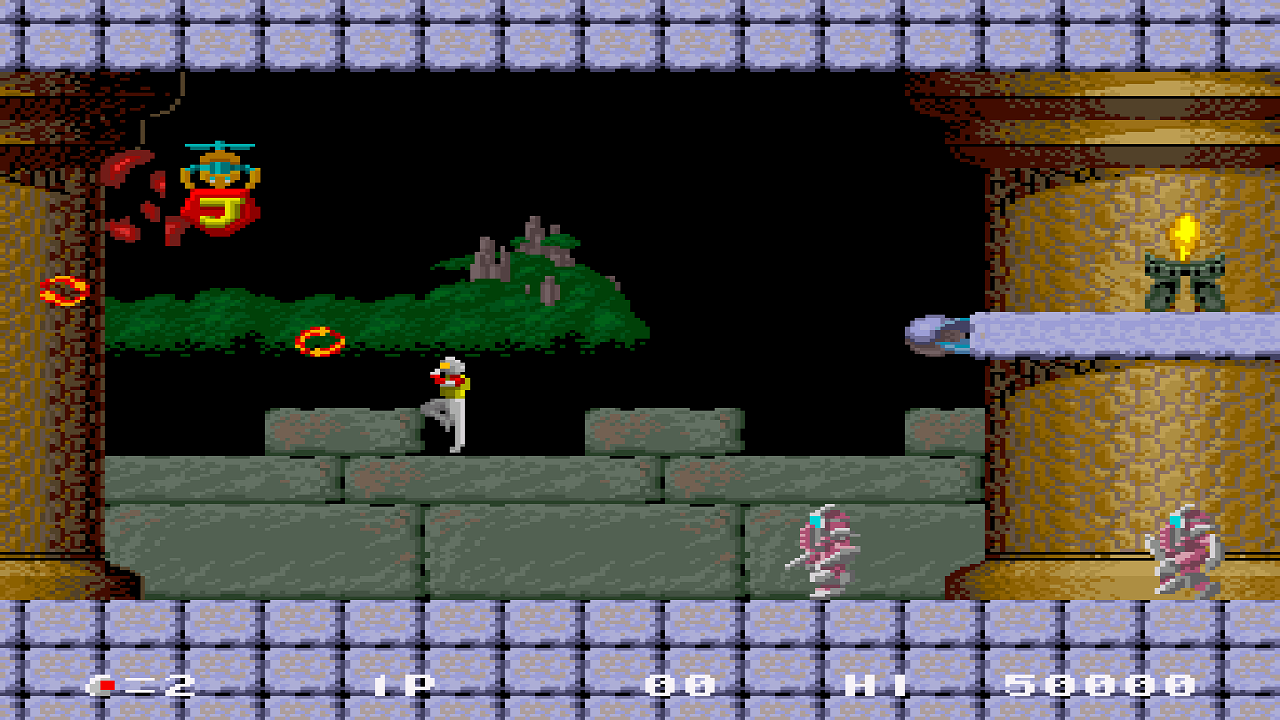
And then there are the dozens of beautifully pixelated enemies – seriously they look damned lovely for the time, as did Chelnov. But Chelnov is not taking their onslaught lying down. Nope, he’s doing it while running forwards, backwards, somersaulting and doing back-flips. He’s also got a massive arsenal of weapons. You start the game with a little pew-pew yellow laser, and graduate up to spinning rings of fire, spinning balls of spiked chains, and even homing missiles. And none of that bloody matters when you brush up against the reverse button for the umpteenth bloody time! Continue Game? You’re damn right I will!
Fighting the bosses is the only time that the game stands still. This is so you can witness how the game shellacs you with Chelnov’s fluids. Again, depending on which version of the game you played, you either got the original monsters in the arcade, or the new ones on the Mega Drive. Everything from the scenery to the bosses were redone to look like the ancient world. In the arcade version, some of the monsters look like giant budgies with fish fins, surrounded by rotating wheels – don't ask me, ask the Japanese. Then there are the disembodied arms: huge ones the size of your character that poke out of the ground trying to grab you.
The final boss looks the same in both versions – it’s the Alien from the original 1979 film, except this one only has a torso and one arm. Oh, and he’s holding a sword… and he craps miniatures of himself! Just how many meds the dev team were on at the time is anyone's guess, but I think they arrived in a wheelbarrow. And then comes the ending. After fighting your way across all the levels, you receive the digital equivalent of a poke in the eye. If you want something remotely happy, buy American! On the Mega Drive, Chelnov beats the bad guys on the Statue of Liberty after having run all the way from Russia, and having freed the world from the Deathtarians, he stands defiant. In the Japanese version, you beat the monster, there's a huge explosion on the Statue of Liberty's head and then the game says this:

So, he runs. He runs along a road and off screen as the end credits roll, the New York skyline in the background. Then, an enemy helicopter nonchalantly flies across the screen, following our hero. A burst of gunfire and Chelnov's death sound and you feel your knees buckle. What the m***********g f***k! What is wrong with you, Data East?! I was 10 years old when I played this and you decide to drop this endgame reality bomb on me!
You guys are the reason my generation invented Ritalin!
That's not to say that the American ending is any better. Chelnov scores the victory but there’s no mention of him rescuing his sister. I have a feeling that somewhere in the bowels of the Statue of Liberty, Chelmi is wondering where the heck big brother is and why she can hear the end credits music. Maybe in some sort of weird timey-wimey way, she engineered the helicopter that killed Chelnov and took out the Japanese one by mistake.
PROS:
A blue-collar, Russian hero.
Great soundtrack.
Smooth character design.
Butt-kicking in all directions.
A difficulty curve that does back-flips.
CONS:
Forced. Side. Scrolling.
“There’s… too many of them!”
That ending…

For all its controversies, Data East had the knack for cranking out some of the most memorable titles of the arcade era. 30 years on, those titles are still challenging gamers. I’ve done the math: considering how many of their games I’ve played, I must have financed somebody’s holiday home. Keep on running, Chelnov! I hope you found that peaceful home.

Please login to post comments.
More Features
Five Best Announcements From Gamescom Opening Night Live 2026
Gamescom Opening Night Live 2026 has passed, delivering yet another stacked show filled to the brim ...
26-08-26 Read more

The Witcher 3 Remastered Stole The Show at Gamescom – Here’s What to Expect
While we knew CD Projekt Red was going to debut its Songs of the Past expansion pack for The Witcher...
26-08-26 Read more
Here's How Long it Will Take to Watch These Modern Anime
We've recently been exploring how long it would take you to watch certain anime, if your'e curious about...
21-08-26 Read more
GTA: Vice City Revisited - What Made It So Good?
2002’s Grand Theft Auto: Vice City holds nothing but pleasant memories for both myself and the many ...
20-08-26 Read more

11 Unforgettable Missions From Grand Theft Auto: Vice City
We’ve still got a ways to go before we all collectively make our (extremely) long-awaited return to ...
11-08-26 Read more

Five Hidden Anime Gems You Can Watch on Prime Video South Africa
While Crunchyroll remains the biggest legitimate streaming giant, Netflix and Amazon are slowly adding...
05-08-26 Read more
Ten Great RPGs You Can Play on a Low-End PC in 2026
If you’re one of the many gamers making a jump from console to PC lately but you can only get a modest...
03-08-26 Read more
Every Main Outlast Trial Ranked by Brutality
For three years now (Early Access included), Red Barrels has been producing top-notch multiplayer horror...
24-07-26 Read more

LORGAR Gaming Gear Officially Arrives at Nexus Hub
LORGAR, the international gaming peripherals brand, is now officially available at Nexus Hub. Already...
24-07-26 Read more
The Origins of Sea Shanties and Why Johnny Must Leave Her
Like many Assassin’s Creed fans with good tastes, I become enamoured by sea shanties. First featured...
16-07-26 Read more