Latest Updates
Hannah Montana: Rock Out The Show (PSP Essentials) now available pre-owned.
KnightFall500 has just posted to What was the last game you finished?
KnightFall500 has just posted to What was the last game you finished?
KnightFall500 has just posted to Games with no threads: News and Trailers
KnightFall500 has just posted to Games with no threads: News and Trailers
Tea has just liked Review: Fire Emblem: Fortune's Weave
Who's Online

Please sign in to add comments
09 October at 16:07

09 October at 15:22
09 October at 14:36
09 October at 14:18
09 October at 14:04
09 October at 13:24
09 October at 13:11
09 October at 13:06
09 October at 12:11
09 October at 12:11
Cart Contents
| Item: | Price: | Qty: |
|---|---|---|
| Total: R 0.00 | ||
User Content
Latest Poll
Forums
 The SPACE News and Discussion thread!
Author
Post

Nah nothing bad is gonna happen Dec 2012. The only things we maybe need to worry about space wise, in the near future, is a big solar flare hitting us (we are currently a solar maximum) and our weakening magnetic shield not being able to protect us. Or some yet undiscovered comet/asteroid hitting us. Both instances have a low chance of happening, but if I had to I would bet money on the big solar flare happening in the next decade.
If you are interested in what is happening space wise every day then I recommend checking out these two youtube channels
Solar physicist who focuses on solar activity and climate change
http://www.youtube.com/user/drkstrong?feature=g-user-u
I little more conspiracy theory like but this guy still looks at all the available data and lets the viewer know what he thinks of it but you can still check on the stuff for yourself
http://www.youtube.com/user/Suspicious0bservers?feature=g-user-u
Here are also some useful links to web based simulators, webcasts and other stuff that everyone might find interesting. If you have any other sites please post. It will be interesting to cehck them out!
Planet alignment Simulator. I have it linked to ISON (that comet that is we will see in Nov 2013) but you can serch for anything in our solar system really.
http://ssd.jpl.nasa.gov/sbdb.cgi?sstr=ison;orb=1;cov=0;log=0;cad=0#orb
Another simulator - pretty and educational
http://www.sunaeon.com/#/solarsystem/earth/surface/
Similar to the one above
http://www.solarsystemscope.com/
Collection of updated charts, graphs and images on solar data like Solar winds, active regions on the sun, solar xray.. some of it is like "swoosh" way over a persons head, but some is easy to read with a bit of reserach.
http://solarimg.org/artis/
Current SDO pics
http://sdo.gsfc.nasa.gov/data/
SDO movie theater - you can set a date range and choose one of the image types to view
http://sohodata.nascom.nasa.gov/cgi-bin/soho_movie_theater
Like the above
http://stereo.gsfc.nasa.gov/cgi-bin/images
More solar visualations
http://www.helioviewer.org/
Night sky simulator as seen from any location
http://neave.com/planetarium/
Live Webcasts for space events
http://events.slooh.com/
Hong Kong Observatory Live Webcasts
http://www.weather.gov.hk/gts/event/webcast_e.htm
If you are interested in what is happening space wise every day then I recommend checking out these two youtube channels
Solar physicist who focuses on solar activity and climate change
http://www.youtube.com/user/drkstrong?feature=g-user-u
I little more conspiracy theory like but this guy still looks at all the available data and lets the viewer know what he thinks of it but you can still check on the stuff for yourself
http://www.youtube.com/user/Suspicious0bservers?feature=g-user-u
Here are also some useful links to web based simulators, webcasts and other stuff that everyone might find interesting. If you have any other sites please post. It will be interesting to cehck them out!
Planet alignment Simulator. I have it linked to ISON (that comet that is we will see in Nov 2013) but you can serch for anything in our solar system really.
http://ssd.jpl.nasa.gov/sbdb.cgi?sstr=ison;orb=1;cov=0;log=0;cad=0#orb
Another simulator - pretty and educational
http://www.sunaeon.com/#/solarsystem/earth/surface/
Similar to the one above
http://www.solarsystemscope.com/
Collection of updated charts, graphs and images on solar data like Solar winds, active regions on the sun, solar xray.. some of it is like "swoosh" way over a persons head, but some is easy to read with a bit of reserach.
http://solarimg.org/artis/
Current SDO pics
http://sdo.gsfc.nasa.gov/data/
SDO movie theater - you can set a date range and choose one of the image types to view
http://sohodata.nascom.nasa.gov/cgi-bin/soho_movie_theater
Like the above
http://stereo.gsfc.nasa.gov/cgi-bin/images
More solar visualations
http://www.helioviewer.org/
Night sky simulator as seen from any location
http://neave.com/planetarium/
Live Webcasts for space events
http://events.slooh.com/
Hong Kong Observatory Live Webcasts
http://www.weather.gov.hk/gts/event/webcast_e.htm
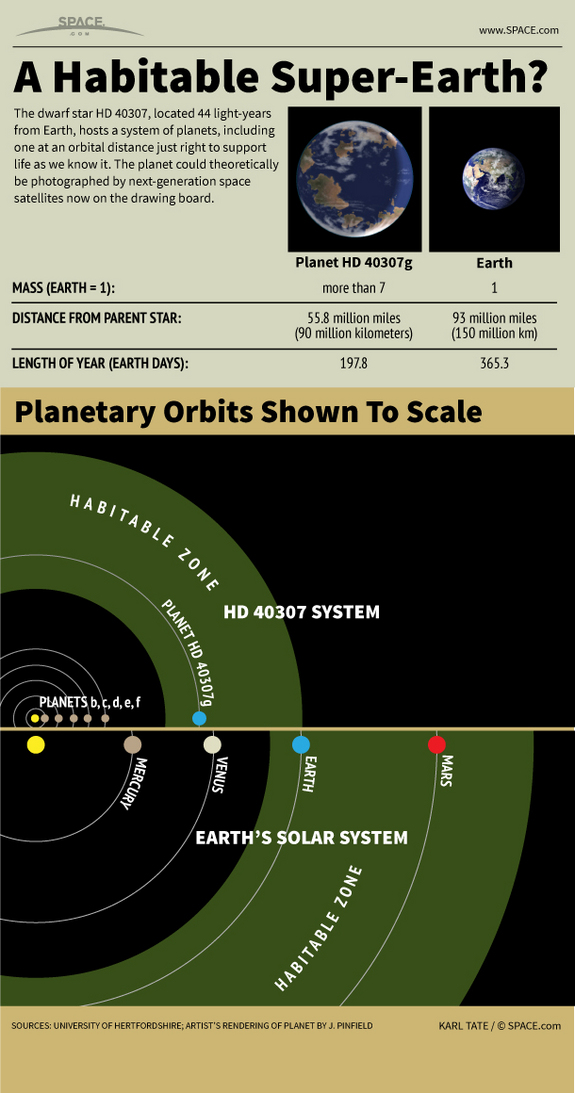
Source SPACE.com: All about our solar system, outer space and exploration
Super-Earth' Alien Planet May Be Habitable for Life
Astronomers have detected an alien planet that may be capable of supporting life as we know it — and it's just a stone's throw from Earth in the cosmic scheme of things.
...read more
'Orphan' Alien Planet Found Nearby Without Parent Star
Astronomers have discovered a potential "rogue" alien planet wandering alone just 100 light-years from Earth, suggesting that such starless worlds may be extremely common across the galaxy.
...read more
Posty  06 March 2007
1687
06 March 2007
1687
06 March 2007
1687
NASA's not sharing a 'historic' find on Mars... yet
Data from a sample of Martian dirt could be earth-shattering, but the space agency is taking time to check its work.
It seems NASA and the Curiosity rover have found something exciting and nerd-tastic on Mars, but the space agency's scientists are holding back for now, despite how painful it appears to be for them.
NPR science correspondent Joe Palca happened to be in the room recently when John Grotzinger, lead scientist for the Curiosity mission at NASA, started receiving data on his computer from the rover's on-board chemistry lab, also known as SAM (sample analysis at Mars). SAM and NASA scientists on Earth have been busy analyzing a sample of Martian soil of late, and apparently the dirt from the Red Planet has a secret to tell.
"This data is going to be one for the history books, it's looking really good," Grotzinger said in the story that aired yesterday.
And that's about all he said.
Grotzinger and NASA have remained mum on what exactly Curiosity may have found in the Martian soil, saying it could be several more weeks until they're able to verify the data. The scientists need to make sure whatever earth-shattering find they have isn't an error or perhaps some kind of stowaway molecule or whatever it may be that hitched one really long ride from Earth.
So I contacted another space smarty-pants type not associated with NASA to see if he might have a guess.
Lewis Dartnell is a leading astrobiologist at The Centre For Planetary Sciences at UCL/Birkbeck in London. He makes it clear that with so little to go on, no one outside of NASA can know what the agency thinks it has, but, he says, "the SAM instrument is designed to detect organic molecules on Mars, so the smart money is on an announcement along those lines."
That's right, the smart money is on what we all were already thinking -- LIFE ON MARS.
The seas may be rising and more superstorms may continue to threaten humanity's most important megalopolises, but there could soon be an emerging market for condominiums on Mars to take our minds off of such challenges.
What do you think NASA's found on the fourth rock from the sun? Let us know in the comments. Or just tell us you know what it is, but then don't really tell us until next month.
Source
I can't wait to hear what they found!!!!


DEATHGIGAS  10 March 2007
12680
10 March 2007
12680
10 March 2007
12680
KnightFall500  03 July 2009
14588
03 July 2009
14588
03 July 2009
14588

Po!sonCupcak3  12 September 2011
225
12 September 2011
225
12 September 2011
225
Corrosive said ...'Orphan' Alien Planet Found Nearby Without Parent Star
Astronomers have discovered a potential "rogue" alien planet wandering alone just 100 light-years from Earth, suggesting that such starless worlds may be extremely common across the galaxy.
...read more
http://cdn.memegenerator.net/instances/400x/30623117.jpg
pretty...
EDIT: Site with full gallery
http://earthobservatory.nasa.gov/Features/NightLights/
Earth at Night
This new global view of Earth's city lights is a composite assembled from data acquired by the Suomi National Polar-orbiting Partnership (NPP) satellite. The data was acquired over nine days in April 2012 and 13 days in October 2012. It took 312 orbits to get a clear shot of every parcel of Earth's land surface and islands. This new data was then mapped over existing Blue Marble imagery of Earth to provide a realistic view of the planet.
The image was made possible by the satellite's "day-night band" of the Visible Infrared Imaging Radiometer Suite, which detects light in a range of wavelengths from green to near-infrared and uses filtering techniques to observe dim signals such as city lights, gas flares, auroras, wildfires and reflected moonlight.
The day-night band observed Hurricane Sandy, illuminated by moonlight, making landfall over New Jersey on the evening of Oct. 29. Night images showed the widespread power outages that left millions in darkness in the wake of the storm.
Image credit: NASA's Earth Observatory/NOAA/DOD
Source
EDIT: Site with full gallery
http://earthobservatory.nasa.gov/Features/NightLights/
Cool thanks Magius. I will check his twitter out
more news...
more news...
Voyager 1 Spacecraft Enters New Realm at Solar System's Edge
NASA's Voyager 1 spacecraft has discovered a new layer of the solar system that scientists hadn't known was there, researchers announced today (Dec. 3).
Voyager 1 and its sister probe Voyager 2 have been traveling through space since 1977, and are close to becoming the first manmade objects to leave the solar system.
Scientists haven't been sure exactly when that exit would occur, and now say the spacecraft are likely in the outermost region of the solar system, which is defined by the extent of the heliosphere, the large bubble of charged particles the sun puffs out around itself. Voyager 1, in particular, has entered a new region of the heliosphere that scientists are calling a "magnetic highway," which allows charged particles from inside the heliosphere to flow outward, and particles from the galaxy outside to come in.
read more
@Magius "Things you might say if you flunked Astro101: "If we ever send humans to the Sun, it's probably best to go at night" lol!
Golden Spike to Offer Commercial Human Missions to the Moon
A group of space experts, media figures and even politicians announced today a new commercial company to bring paying passengers to the Moon. The Golden Spike Company is looking to “implement and operate a human space transportation system at commercially successful price points,” the company says on their website, focusing “on generating a sustainable human lunar exploration business that generates profits through multiple high value revenue streams.”
Read rest of the article
FatalGlory  29 December 2011
675
29 December 2011
675
29 December 2011
675
I thought this was a joke at first...
White House Petition: Could we Build the Starship Enterprise?
Earlier this year, an engineer who goes by the name of BTE Dan proposed building a full-sized, ion-powered version of a Constitution-Class Enterprise – from the original Star Trek – saying it could be built with current technology and could be completed within 20 years. Now, BTE Dan has started a White House petition — not to build the Enterprise but to just do a feasibility study and conceptual design of the USS Enterprise interplanetary spaceship. As of this writing, the petition has 1,414 signatures of the 25,000 needed by January 21, 2013 to be considered by the Obama administration.
Read more