Latest Updates
Who's Online

Please sign in to add comments

Cart Contents
| Item: | Price: | Qty: |
|---|---|---|
| Total: R 0.00 | ||
User Content
Latest Poll
Review
Review: They Are Billions
For the Humans!

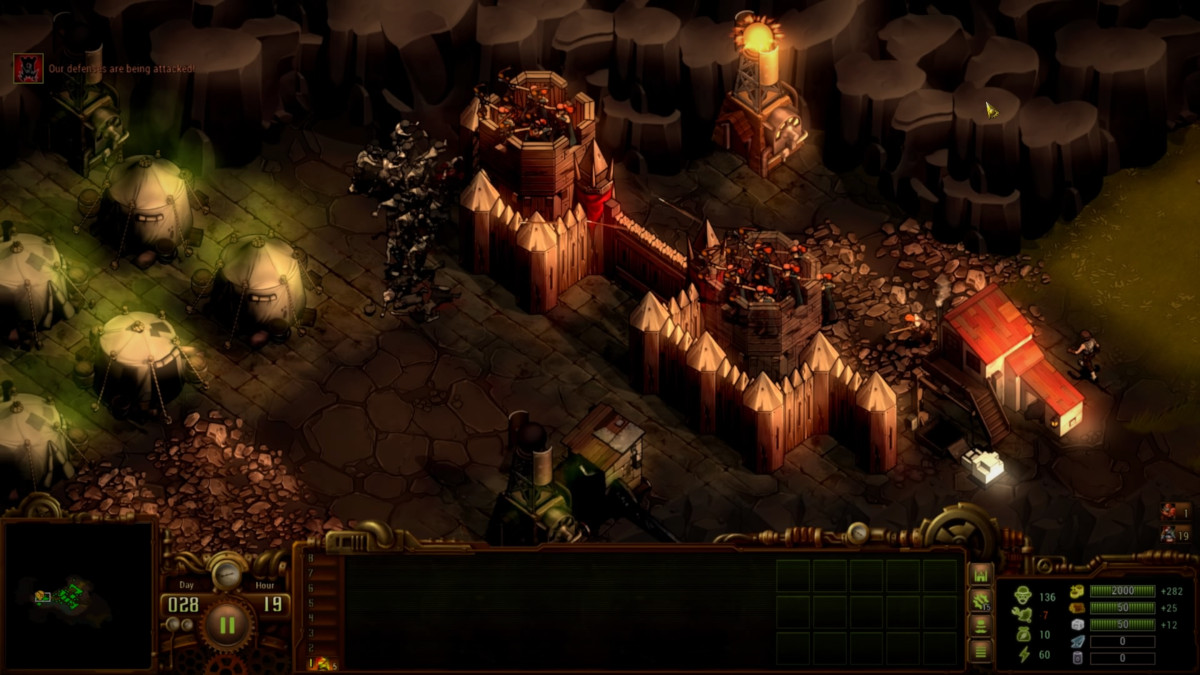
Turtling in a real-time strategy game, much like camping in a first-person shooter, is an under-appreciated artform. If you’re tired of the multi-player centric, fast-paced, APM-obsessed RTS games that have dominated the last decade, They Are Billions is an appealing prospect. Sure, you can build and command a myriad of infantry or mechanised units and send them around the map to clear out pockets of infected, but their primary purpose is to be garrisoned away in stone towers, tucked behind several layers of walls and wire traps, backed up by a line of Executor cannons, holding a chokepoint against hordes of infected.
Numantian Games first released They Are Billions as an early access title in late 2017, slowly iterating and improving the game until it was ready for launch on PC this June, alongside a new campaign mode. This month, console players get their hands on a port from BlitWorks, featuring the excellent Survival mode and “Weekly Challenges” (with an online leaderboard to post your score). Unfortunately, the campaign is currently AWOL, but the price is also lower than on PC. I suspect it’ll be introduced as DLC down the line.
Without the campaign, there’s not much in the way of a narrative, but the addictive gameplay loop – that always has you wanting to build one more structure, purge one more corner of the map, or try to survive one more wave of infected – makes up for this deficit.
They Are Billions puts you in the boots of a colony administrator, attempting to re-establish civilisation in a steampunk future overrun by hordes of the infected. Without the campaign, there’s not much in the way of a narrative, but the addictive gameplay loop – that always has you wanting to build one more structure, purge one more corner of the map, or try to survive one more wave of infected – makes up for this deficit. Unfortunately, an RTS designed with mouse-and-keyboard in mind, coupled with the premise of rendering thousands of infected on-screen, has not made the transition to console unscathed.

Starting with the positives, the Survival mode in They Are Billions has a basic premise – survive in your selected region, for a chosen length of time, against various infection levels – and this is supported by simple yet deep mechanics that’ll never leave the player stuck in a technological rut, so long as your defences hold. Letting any infected reach your undefended structures is a recipe for disaster, as infected buildings spew out new infected, creating a domino effect that is nigh on impossible to contain and will swiftly overrun your colony.
Starting out in the centre of the map with an HQ and small army, choices immediately present themselves. Housing to boost your worker population is an obvious one, but you can’t expand your population without food sources. Sawmills and quarries for lumber, stone, and iron are a must (especially if you want fortifications ASAP), but power is a consideration for advanced structures. Industrial buildings are there for those that favour the tech-rush approach, providing research for new structures, units, and upgrades, but the resource and worker cost is prohibitive, leaving you with fewer defences and infantry.
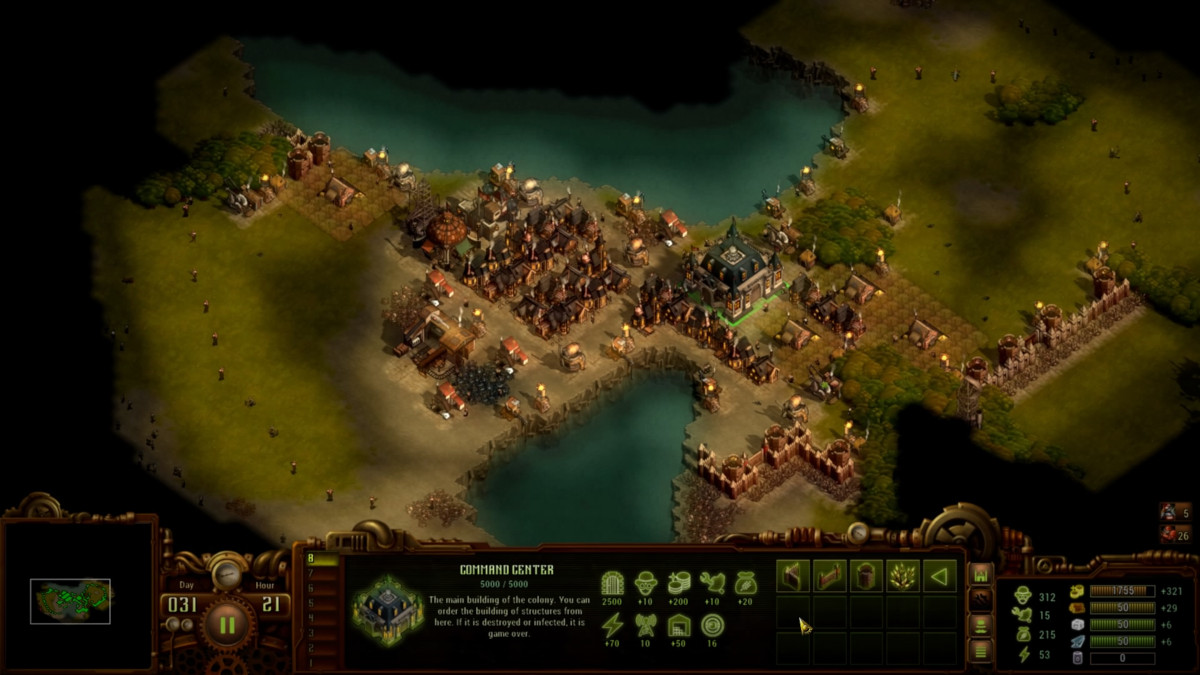
Of course, you also need to scout out and assess your starting location and plan accordingly. Each map is randomly-generated, and each region offers different pros and cons – such as increased farmland at the expense of natural barriers. Or abundant quarriable materials that also limit viable building space. It’s tempting to hunker down near your HQ, but you’ll want to risk pushing outwards with your army to find more resources and defensible chokepoints. The problem? Juggling limited troops and resources in the opening days of your colony. You’ll need to move troops between towers based on approaching hordes, shut down and restart industries to free up resources, and continuously upgrade your defences as the days tick on and the attacking hordes grow in size.
Thankfully, a lot of thought has gone into assigning orders, the autonomy of your units, and how upgrades are managed. First up, you can pause the game at any time to assign movement orders to your troops, pick an upgrade or two to research, sell and buy resources, or set construction orders for new defences. Secondly, your units and defensive structures work in harmony by default, with short-ranged but powerful soldiers backed up by mid-range archers, or long-range snipers. Creating a mixed squad is always effective and requires little micro-managing. Thirdly, you can assign a myriad of behaviours to units and defensive structures. You can lay out patrol routes for your infantry or set defensive towers to prioritise special infected. Finally, upgrades are almost always iterative, allowing you to progress from a basic tent to stone house, or Great Ballista tower to Executor cannon, without the need to destroy and rebuild. All these aspects allow you to focus on the greater scheme of expanding your reach, while your units will hold the line valiantly.
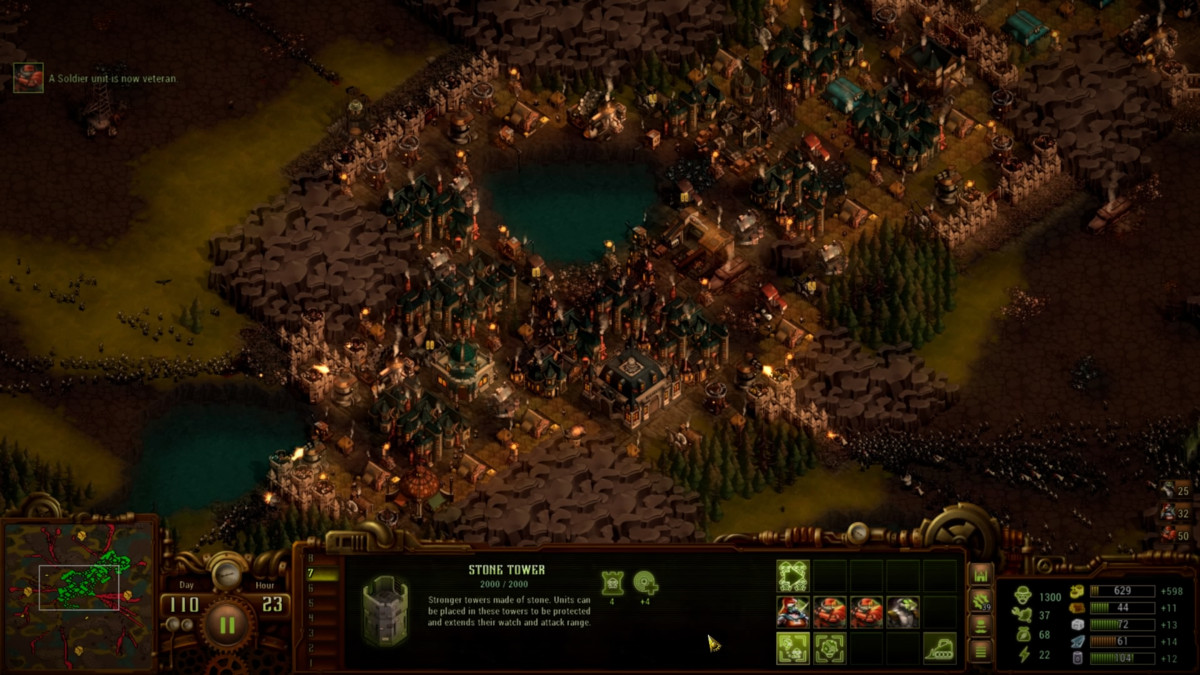
Unfortunately, it doesn’t take long to discover the problems with the console port. First and foremost, BlitWorks needs to go play some other RTS games from the last two console generations and overhaul the controls; there’s a good reason they lock the selection cursor to camera movement. They Are Billions moves the camera with the right stick but treats the left analogue stick as a mouse curser, something that repeatedly clashes with the console-specific changes that do work (like overriding the right stick camera control if the cursor drifts too close to the edge of the screen). There’s intelligent unit selection, though it requires you hold a button and drag the left stick to create a selection box, while "double clicking” on a unit or structure can’t seem to decide if it wants to select everything on the screen, or on the entire map (deleting every wall in my colony was an inglorious end to one run). I got used to the controls over time, and with the day-one patch the cursor is locked when placing structures, but it remains a nagging issue throughout your playtime. It’s worth noting for those with an Xbox console, They Are Billions supports mouse and keyboard - if you have the setup.
Unfortunately, an RTS designed with mouse-and-keyboard in mind, coupled with the premise of rendering thousands of infected on-screen, has not made the transition to console unscathed.
Next up is the performance. Despite the simplistic visuals, They Are Billions looks and sounds great. Up close, the sprite work is surprisingly detailed and it’s always a joy to watch the infected hordes clash against your defensive line - their growls and screeches accompanied by the rattle of gunfire and epic music. In the opening hours of any given match, and at the default zoom level, the game plays smoothly. However, zoom out to see an overview of the map, or survive long enough to see the final waves of infected descend on your colony, and the frame rate tanks. The performance also seems worse in general in later regions you unlock as you play. Furthermore, laggy performance feeds back into the imprecise control scheme, compounding issues. Sure, this is less of an issue on the Pro and X consoles, but is still present. Much like the control scheme, the pause-and-command system allows you to work around this issue, but it’s far from ideal.
All that said, I’m eagerly waiting on the campaign to provide some narrative structure and a new progression system, but the Survival-oriented mode available at launch still provides hours of fun; challenging you to survive for longer, in harsher environments, against larger hordes, while refining your strategy. They Are Billions on console is still a great survival RTS, but is let down by poor controls and variable performance. Despite those issues, I’d recommend it to RTS fans craving new content (it's not as though we get many RTS games on console), but take note it still requires some work.
NOTE: I’ll update this review once the campaign is available for the console versions (and hopefully several patches will have addressed the control and performance issues).


There are 5 comments
 Coffeboy


Please login to post comments.
More Reviews

Review: Fire Emblem: Fortune's Weave
It’s legitimately very hard to believe that it’s been seven whole years since Fire Emblem: Three Houses...
05-10-26 Read more
Review: Control Resonant
It’s been seven years since the events of developer Remedy Entertainment’s original 2019 Control title...
02-10-26 Read more

Review: Gears of War: E-Day
Xbox’s flagship Gears of War series has had a bit of an identity crisis over the last decade. After ...
01-10-26 Read more

Review: Gachiakuta
Gachiakuta took the world by storm when it first aired from July to December 2025. With its gritty animation...
28-09-26 Read more

Review: Elden Ring: Tarnished Edition (Switch 2)
What can I say about Elden Ring that hasn’t already been said? From Software’s magnum opus originally...
21-09-26 Read more

Review: The Blood Of Dawnwalker
Rebel Wolves’s The Blood of Dawnwalker has often been compared to The Witcher III: Wild Hunt from fellow...
15-09-26 Read more

Review: Marvel's Wolverine
When I think about some of PlayStation Studios’ most consistent developers, Insomniac Games always ranks...
10-09-26 Read more

Review: Dumb Ways to Build
Originally a public service announcement which discouraged the Australian public from thoughtless activity...
09-09-26 Read more

Review: Orbitals
Booting up Orbitals for the first time, I was immediately hit by a warm wave of nostalgia like the food...
08-09-26 Read more

Review: Onimusha: Way of the Sword
It’s a good year to be a fan of action games, and an even better year to be a fan of Capcom. After delivering...
31-08-26 Read more

Overview
Developer
Numantian Games
Publisher
BlitWorks
Platform
PlayStation 4, Xbox One
Release date
3 July 2019