Latest Updates
Who's Online

Please sign in to add comments

Cart Contents
| Item: | Price: | Qty: |
|---|---|---|
| Total: R 0.00 | ||
User Content
Latest Poll
Review
Review: Pragmata
Alone together.

I went into Capcom’s Pragmata with mixed expectations, which unfortunately seems to be the default audience hype-switch setting these days, and ended up pleasantly surprised with what it had to offer. The gameplay (while satisfying) might not be the most revolutionary thing you’ve ever seen, but its almost nostalgic simplicity, interesting setting, surprisingly endearing and emotional character work, and “interesting-enough-to-propel-you-forward” storyline mystery more than makes up for it.
Set within a lunar research base known as The Cradle, our protagonist Hugh Williams awakens after a tremor brings his crew’s recent arrival to a screeching, catastrophic halt. An android with the appearance of a human child (later dubbed “Diana” by Hugh, shorthand for her full production name) tends to his wounds before aiding him in fending off a handful of hostile bots – all seemingly controlled by the hostile station-wide IDUS AI program. Diana’s innate hacking ability allows Hugh to make short work of the machines, and the two venture deeper into the facility as they attempt to make contact with Earth.

Pragmata’s gameplay consists of a blend of exploration, light platforming, combat encounters, and collectable hunting. The numerous areas of the Cradle aren’t exactly difficult to navigate, and you’ll likely never find yourself unsure of where to head to next – and Diana’s scanning ability can be activated at any point, plopping down a marker guiding you to the next objective or place of interest. Not rushing from marker to marker is a good idea, though, if you’re looking to track down the many collectables scattered around each zone (although some are impossible to miss). These include important upgrade materials for Hugh’s weapons and suit, hacking/combat mods, and Read Earth Memories (or REMs) – holographic representations of objects from Earth that can be displayed in the game’s Shelter hub area.
Pragmata’s gameplay consists of a blend of exploration, light platforming, combat encounters, and collectable hunting.
While exploration might be fairly standard, as far as third-person action titles go, Pragmata’s primary combat system throws in an interesting (often times stressful, in the best possible way) hacking minigame that triggers when aiming a weapon at an enemy – as long as they’re not too far away from our protagonist. Hugh can fire away at an approaching rogue bot all he wants, but without Diana’s hacking expertise, his damage output won’t reach its peak potential.

This hack takes the form of a grid that appears on the right side of the screen, requiring players to guide a block over damage/hack mod ability icons (using the face buttons on PS5) before stopping on the final “activation” square to finalise the breach and lock in any bonus effects from the icons picked up along the way. Keep in mind that the game continues running while this is all going on, and if you’re being swamped with enemies, you’ll have to keep shifting your focus from the centre to the right of the screen – adding another excellent, immersive, and much needed layer of tension to combat.
Having said that, I wouldn’t necessarily call Pragmata’s average combat encounter particularly difficult – and if you’re obsessively hunting down upgrade materials and enhancing your offense/defense/hacking at the Shelter whenever possible (easily reached via conveniently placed vents around the facility), the overall enemy threat level is made even less of an issue. Most bots have easily identifiable weak points to target after an initial hack as well, rewarding the player for approaching attacks methodically as opposed to blindly unloading their weaponry with zero thought. This challenge level and logic also applies to boss fights, which are always fun to engage with – in both the visual and gameplay departments.
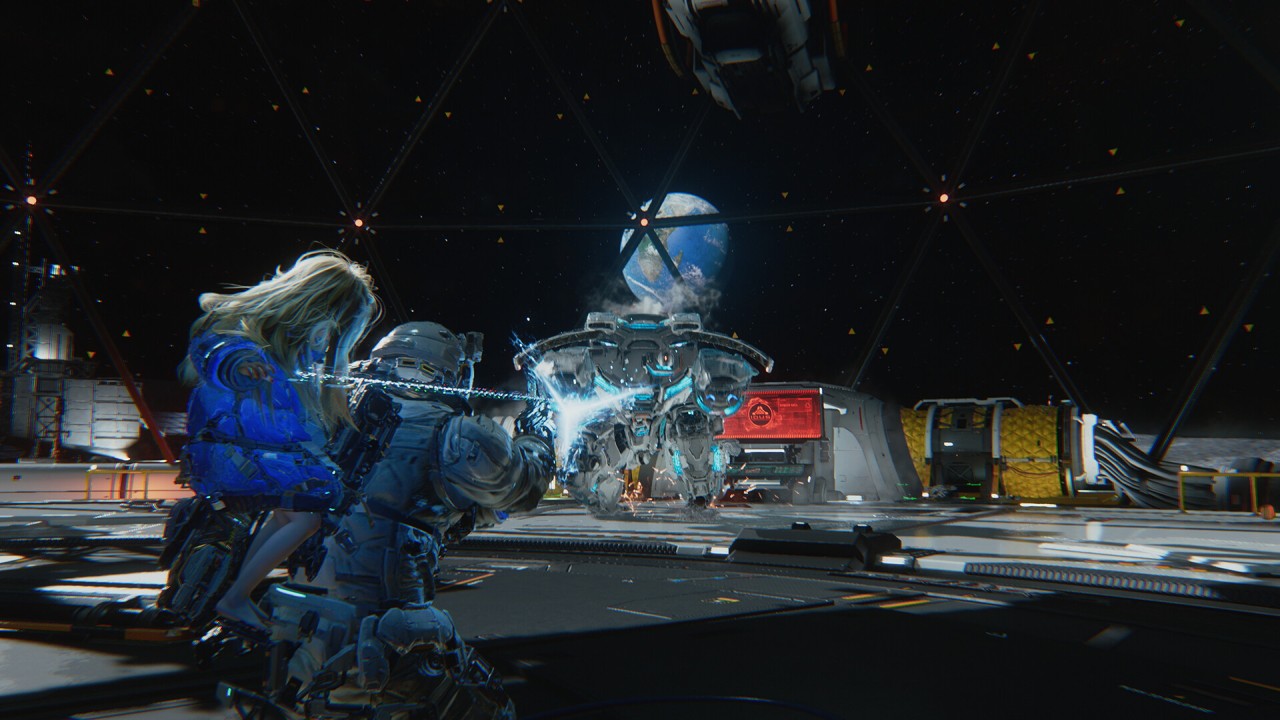
Weapons come in different flavours – some focus on pure offense (in charged rifle form, for example), while others are more utility-oriented (slowing down or distracting foes). Hugh’s ever-present primary upgradeable weapon doesn’t have finite uses like the other lootable options out there but does require a cooldown of sorts after extended periods of activity, forcing the player to ensure they have backup firepower on hand. The game is rather generous with its weapon/hacking mod drops, though, often placing them in strategically perfect locations during enemy/boss battles. If you run into a conspicuous gathering of weaponry, you can bet things are about to get fast and/or furious.
The game is rather generous with its weapon/hacking mod drops, though, often placing them in strategically perfect locations during enemy/boss battles.
While Pragmata’s combat and story is undeniably enjoyable enough to hold the average player’s interest all the way to the finale, I found myself drawn even more to the interaction between Hugh and Diana. There’s an impressive amount of attention paid to making both characters feel alive, believable, and (perhaps most importantly) incredibly likeable – delivered first and foremost through interactions and dialogue. When major plot points take place, you can immediately head back to the Shelter hub and discuss them with Diana. Obtaining one of those already-mentioned REMs unlocks unique dialogue and animations for her too. Interact with her enough times and she may even reward Hugh with an adorable hand-drawn picture. Hell, even just roaming The Cradle can trigger brief exchanges between the two, delivering backstory and character development in equal measure. This is a game where every bit of dialogue is welcomed with open arms, not impatiently skipped over.

The different environments on The Cradle also serve as powerful storytelling elements despite their lifelessness, and you’ll often run into bits of lore in the form of mails between employees, documentation detailing aspects of the facility, and even holographic projectors replaying previously recorded events. As you’d expect, some of these interactable items also trigger musings from Hugh and Diana, though these are nowhere near as meaty as the conversations held during extended roaming sessions or those observed in the Shelter.
I mainly played Pragmata using the game’s performance mode equivalent and, aside from a handful of anti-aliasing issues and Diana’s hair sometimes looking less than ideal during close-up shots, the game ran consistently well. Smooth frame rate aside, I did run into an issue where, after travelling back to the Shelter hub from a mid-level return point vent, all sound effects stopped playing. A quick trip to the main menu before loading back into the game solved the problem, thankfully. Accessibility options are likewise decent, with various selectable presets and individual options available for players to mess around with – including subtitle size/background and enabling/disabling motion blur and depth of field effects.
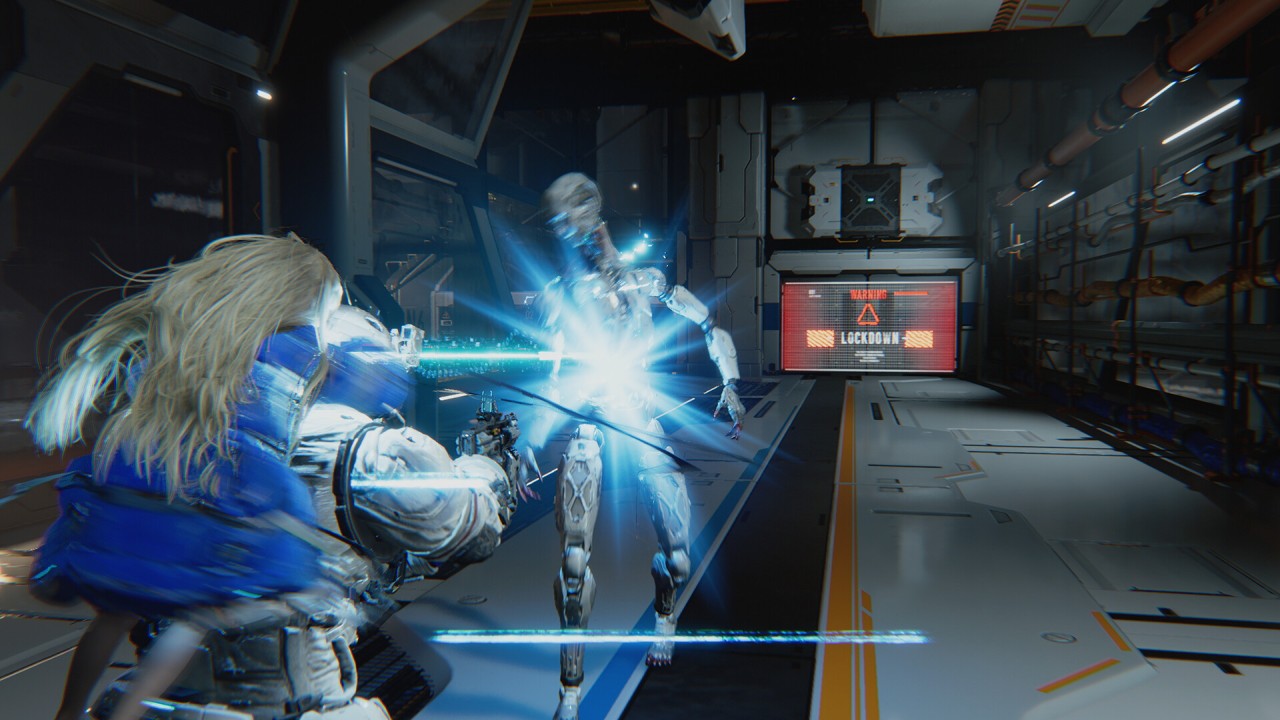
Quick side note for those aiming to play on console – there appears to be no way to adjust controller stick deadzones, so the camera will always have that initial sticky feeling when turned, even with camera sensitivity bumped up. Not a dealbreaker, but I just thought I’d throw that information out there for those who care.
Pragmata combines a satisfying third-person combat system (plus a highly addictive hacking minigame twist) with some truly fantastic and emotional storytelling, all without ever entering the realm of total pretentiousness. Wrapped up in a sci-fi setting and aesthetic that somehow manages to feel fresh and familiar at the same time, this space odyssey is, without a doubt, well worth investing in.
PS5 Review code provided by Capcom | Pragmata is now available at Nexus Hub for R1,099


Please login to post comments.
More Reviews

Review: Elden Ring: Tarnished Edition (Switch 2)
What can I say about Elden Ring that hasn’t already been said? From Software’s magnum opus originally...
21-09-26 Read more

Review: The Blood Of Dawnwalker
Rebel Wolves’s The Blood of Dawnwalker has often been compared to The Witcher III: Wild Hunt from fellow...
15-09-26 Read more

Review: Marvel's Wolverine
When I think about some of PlayStation Studios’ most consistent developers, Insomniac Games always ranks...
10-09-26 Read more

Review: Dumb Ways to Build
Originally a public service announcement which discouraged the Australian public from thoughtless activity...
09-09-26 Read more

Review: Orbitals
Booting up Orbitals for the first time, I was immediately hit by a warm wave of nostalgia like the food...
08-09-26 Read more

Review: Onimusha: Way of the Sword
It’s a good year to be a fan of action games, and an even better year to be a fan of Capcom. After delivering...
31-08-26 Read more

Review: Spa Weekend
I was invited to attend an exclusive preview screening of the film Spa Weekend on August 20th at Sandton...
21-08-26 Read more
Review: SanDisk Extreme Fit USB-C Flash Drive (128GB)
The SANDISK Extreme Fit USB-C™ Flash Drive - 128GB is something that you might not even believe exists...
21-08-26 Read more
Review: Ground Zero Hero
It’s not often that a game comes around with the ability to grip you into a mindless cycle of absolute...
19-08-26 Read more

Review: Marvel Tokon: Fighting Souls
You know, if anybody was going to make a Marvel themed arcade fighting game in 2026, I’m glad Arc System...
18-08-26 Read more

Overview

Add to cart
Developer
Capcom
Publisher
Capcom
Platform
PC, PlayStation 5, Xbox Series
Release date
17 April 2026