Latest Updates
Who's Online

Please sign in to add comments

Cart Contents
| Item: | Price: | Qty: |
|---|---|---|
| Total: R 0.00 | ||
User Content
Latest Poll
Review
Dishonored 2
Killing Me Softly

A few hours in, I found myself standing proudly over an impressive pile of unconscious Overseers, the unhinged religious enforcers in the Empire of the Isle’s “Abbey of the Everyman”. I had lain them out alongside each other in their very own shrine room, appropriate I thought, and was contemplating the discussion they would have once they started to wake. Unlikely to happen any time soon – given Dishonored 2's concessions to gameplay – but the scene had me fondly reminiscing about the last time I had stealthily placed half of the Empire's population into a coma-like state.

While open-world, checklist-type games annoy me, I can still understand the almost-rhythmic, systematic pleasure that comes from clearing out regions – and stockpiling my unconscious foes.
Dishonored 2 picks up from the excellent Knife of Dunwall and Brigmore Witches DLC (if you haven’t played them yet, you should, they’re even better than the original game). Slight spoiler – as only the empress-killer Daud encountered Delilah Copperspoon in his personal quest for redemption, Corvo and Emily are unaware of the threat she poses when she strolls into the Dunwall palace 15 years later. With the backing of the Duke of Serkonos, she sets a plan in motion to claim the entire Empire of the Isles, forcing Emily (or Corvo) to head south and dismantle their seat of power in Karnaca.
Karnaca is a thriving city, made wealthy from silver mining and powered by wind-driven turbines, it makes for a far more attractive setting than Dunwall. Arkane Studios have built an impressively detailed world for Dishonored 2, with massive amounts of lore. While it may feel contrived, your primary targets will conveniently occupy every notable location in the city. Should you indulge in some light exploration, you will walk away from the game with a vast amount of knowledge on the history and culture of the city. At times, it is almost overwhelming, but ensures the world feels like far more than a pretty backdrop.

My fears that the game would quickly whisk you south to Karnaca as part of a cut scene were unfounded. Instead, Dunwall forms part of a lengthy introduction that serves as a tutorial for the core stealth and combat mechanics.
In Dishonored, overheard conversations and collectible books slowly built up the player’s knowledge of the world, and this approach is expanded upon in the sequel. Confident in their lore-building technique, Arkane Studios has littered the environment with maps of the Empire, dozens of books detailing these locations and, given that Karnaca is a much livelier city, crowds of NPCs that discuss distant lands and events. Corvo and Emily are now voiced, engaging in discussions with other characters and providing commentary on events or objects within the environments. While I enjoyed Corvo’s subtle animations in the first game, fully voiced characters allow them to express their feelings, making for a more engaging experience. The “Heart” returns, always ready to dish out cryptic advice, sad or hopeful stories, and reveal the secrets of the people around you. Using it is entirely optional, but it adds even more depth to the game world.
Should you indulge in some light exploration, you will walk away from the game with a vast amount of knowledge on the history and culture of the city.
For some, Dishonored 2’s narrative structure may be its biggest weakness. While the game has its share of twists and turns, and the chaos system slightly alters the environments, each mission follows a rigid pattern from beginning to end; converse with your allies on the “Dreadful Whale”, travel to a location by skiff, complete your task, return to the ship. Dishonored had Corvo returning to the Hound’s Pit Pub between missions, but this location felt more dynamic, with far more NPCs. The latter parts of Dishonored would throw you out of your comfort zone and leave you feeling isolated and vulnerable. Dishonored 2 is a much longer game than the original (my stealthy, no-kill run took 30 hours) and this familiar, rigid structure was increasingly noticeable after the halfway point.
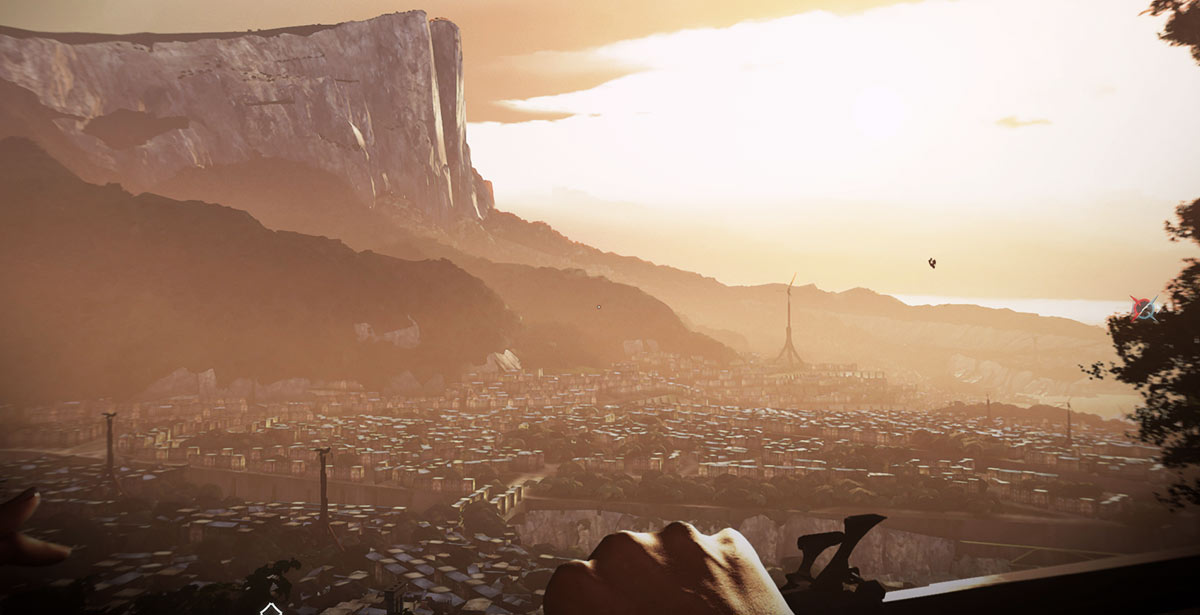
Karnaca provides a beautiful backdrop for many missions, looking even more spectacular when the sun sets.
After a short tutorial and introductory sequence from the perspective of Emily, you have the choice to continue as her (which I did) or take control of Corvo yet again. You are then thrust into a city full of observant guards, opportunistic gangsters, and civilians who can’t decide whether to hate their new overlords or report you to them.
The basic gameplay mechanics feel as smooth as ever: stealth still relies on avoiding line-of-sight and sticking to the high ground, whereas open combat requires carefully-timed parries and counter attacks. There have been refinements, however; non-lethal finishers are now available in open combat or during dramatic slides and aerial attacks. You can launch straight from a sword parry into a choke-hold – all the fun of combat, without the body count.
Opponents range from observant to eagle-eyed based on difficulty, a big shift from the dimwitted guards in the first game. Distractions are no longer a simple one-size-fits-all mechanic; leaving a door or window open will result in a casual investigation; however, snatching a guard from his patrol, will put the rest on alert as they scramble to find their missing comrade, often changing up their initial patrol routes. Unfortunately, there are some AI bugs. I have had opponents staring right over my crouched character one moment, then spotting me through a door the next. Rare, but infuriating when it happens. Make sure to check your stats screen and save often if you’re tackling a “Clean Hands” or “Shadow” run.
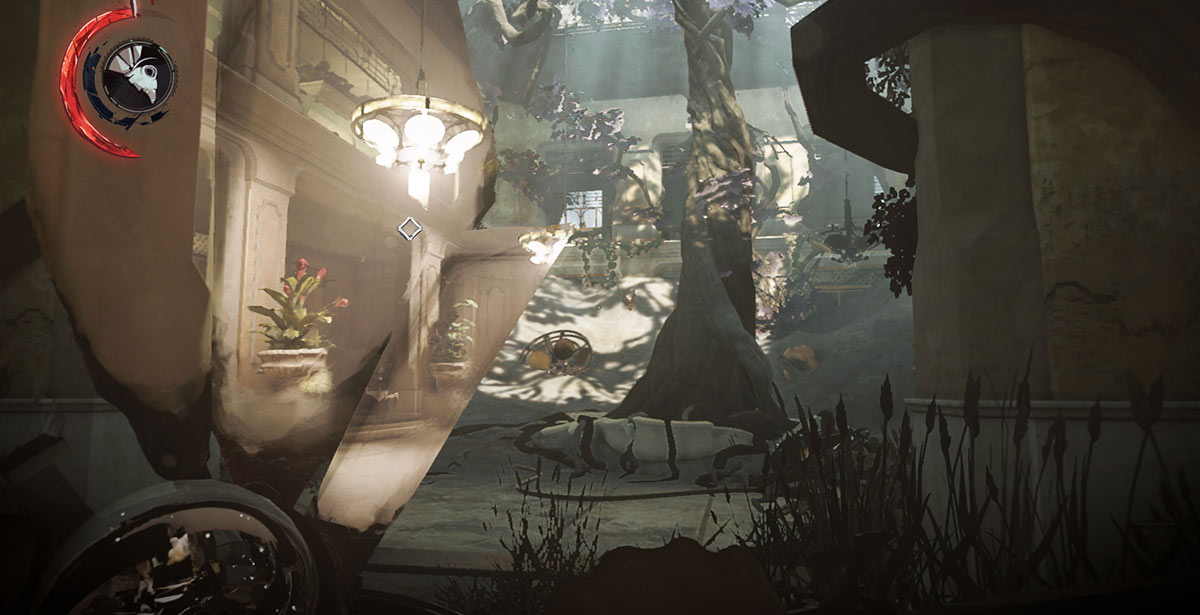
Traveling through a mansion caught between time periods was the highlight for me. Stripped of your normal powers, it felt like an extended puzzle sequence as you dodged guard patrols and circumvented obstacles by shifting quickly between past and present. For those on a high-chaos run, slipping into the past to stab a guard in front of their colleagues before slipping back to the present is incredibly empowering.
Early on, Emily or Corvo will encounter the mysterious Outsider and can gain access to void powers. I say “can” as you can outright refuse these powers, ensuring a substantially tougher, slower, and more tactical run. Corvo retains his powers from the original game, albeit with some new upgrade paths, whereas Emily receives new powers that, while similar, favour combat over stealth. The “Far Reach” power is used to grapple around, rather than Blink, but can be upgraded to pull enemies towards you for a surprise choking (or stabbing). “Mesmerize” renders targets confused and unobservant, allowing you to slip through areas unnoticed, similar to Corvo’s Bend Time power. “Domino” is unique, linking the fates of up to four targets, and was endlessly entertaining in any circumstance. Choking one target will render the others instantly unconscious; cutting the head off one opponent in combat will result the nonsensical, yet spectacular, demise of the others. As with the first game, collectible runes allow you to upgrade your powers, while wearable bonecharms provide smaller boosts to existing skills.

I guess you could go around just stabbing everyone and everything in sight, a gory whirlwind of void powers and sword blows, but what sort of monster would do that?
Whether you choose to engage in stealth or open combat, use void powers or not, kill or don’t kill, the level design in Dishonored 2 is incredible. After two hours spent stealthily subduing most of the Karnaca docks, I discovered a route that, from start to finish, would take perhaps 10 minutes if done skillfully. Admittedly, the route was not without hazards; it went straight through a blood fly infested building. If you thought rats and weepers were bad, you’re in for a stomach-churning surprise.
As with its predecessor, this is a game that will quickly find its way onto the speed running circuit and should generate some awe-inspiring streams. I was surprised how often I could find a route to the rooftops or balconies, allowing me to move undetected and observe enemy movement with less risk.
Whether you choose to engage in stealth or open combat, use void powers or not, kill or don’t kill, the level design in Dishonored 2 is incredible.
Presentation is much improved over the original, especially the lighting, while retaining the stylistic design of the environments and characters. Dunwall is a great mix of steampunk and gothic design, whereas Karnaca has a more Mediterranean-feel with harsh sunlight and stucco buildings. Audio remains impressive with a moody soundtrack, excellent ambient city sounds, clashing swords, roaring pistol shots, demonic whisperings when using void powers, and the eternally satisfying sound of desperately shuffling feet as you choke out yet another unsuspecting victim. One common and distracting issue is shimmering at the intersection of textures (where the wall meets the floor as an example), which always caught my eye, even if it only happens for a second or two.
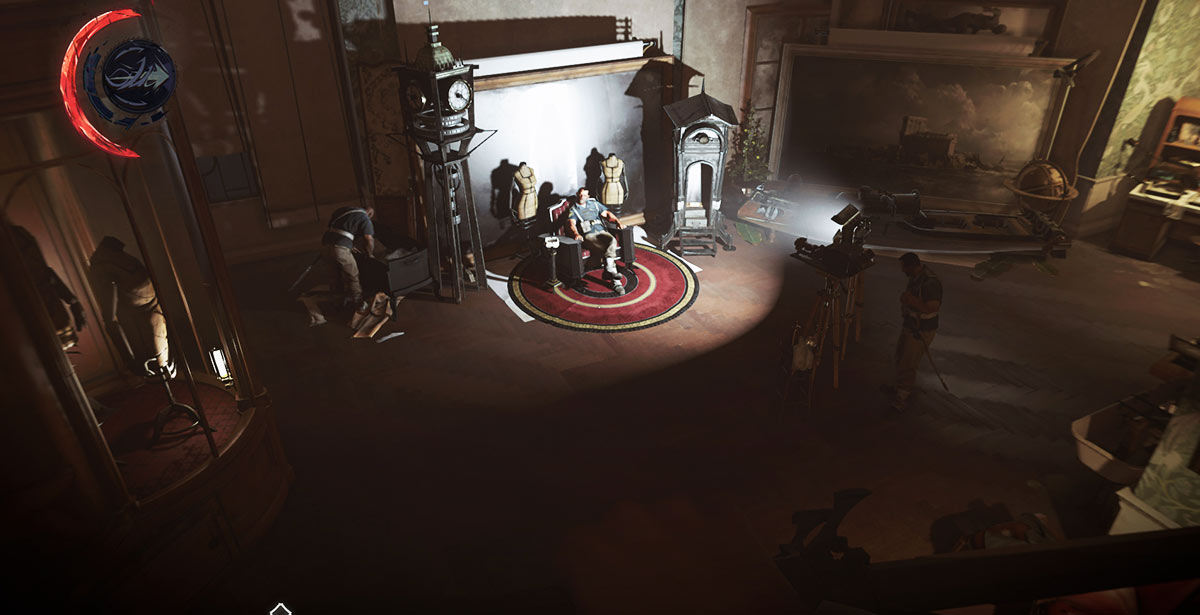
Getting up high should always be your first plan of action. There are many apartments to loot for valuables, runes, and literature, but it is also the perfect spot to observe your enemies without risk of detection. From above, you can swoop in and pick off opponents one by one, leaving the rest increasingly panicked and isolated.
Having stealthily tackled Dishonored 2 as Emily, and dipped my toes into some violent gameplay as Corvo, I can easily recommend this to any fans of the original game, or those that enjoy stealth games in general. The story picks up smoothly from the original, core gameplay is refined, Emily’s new powers are fun to play with, presentation is improved, the level design is complex and rewarding. Whether you want to blitz through the game, sword in one hand and pistol in the other, or slink through the shadows alerting no one, Dishonored 2 caters to any playstyle. While possessing everything I would expect from a good sequel, the narrative, and in turn the gameplay, sticks closely to the template laid out by Dishonored and ends up even more formulaic. As a fan of the genre, and someone with an inordinate love of subduing and stockpiling victims, the game is every bit as impressive as its predecessor but, for some, familiarity might tarnish the experience.


There are 2 comments
 Lurch

Please login to post comments.
More Reviews
Review: Wildwood
The creators and studio behind hit film Coraline (2009), Laika Studios, have done it again, this time...
22-10-26 Read more

Review: Valor Mortis
Now here’s an interesting combination. Developer One More Level’s (of Ghostrunner fame) Valor Mortis...
16-10-26 Read more

Review: Pixel Washer (Early Access)
There’s always something uniquely satisfying about games that’s sole focus is on making something that...
14-10-26 Read more
Review: Hellraiser: Revival
I’ve been a fan of the Hellraiser movies ever since I snuck a VHS rental (yeah, remember those?) of ...
13-10-26 Read more
Review: The Sinking City 2
The Sinking City 2, from Ukrainian developer Frogwares, is less of a sequel than it is a Lovecraftian...
12-10-26 Read more

Review: Fire Emblem: Fortune's Weave
It’s legitimately very hard to believe that it’s been seven whole years since Fire Emblem: Three Houses...
05-10-26 Read more
Review: Control Resonant
It’s been seven years since the events of developer Remedy Entertainment’s original 2019 Control title...
02-10-26 Read more

Review: Gears of War: E-Day
Xbox’s flagship Gears of War series has had a bit of an identity crisis over the last decade. After ...
01-10-26 Read more

Review: Gachiakuta
Gachiakuta took the world by storm when it first aired from July to December 2025. With its gritty animation...
28-09-26 Read more

Review: Elden Ring: Tarnished Edition (Switch 2)
What can I say about Elden Ring that hasn’t already been said? From Software’s magnum opus originally...
21-09-26 Read more

Overview

Add to cart
Developer
Arkane Studios
Publisher
Bethesda Softworks
Platform
PC, PlayStation 4, Xbox One
Release date
11 November 2016